

Day after day, cybercriminals search for new forms of scams to trick their victims into getting their hands on their money. personal, financial data and thus steal their money. In recent times, one of the most popular deceptions among scammers is that of impersonate representatives of companies or government entities.
Among other fraud methods, these types of criminals often use fake profiles on social networks, generally pretending to be customer service assistantsPhone calls or fake websites that imitate the originals and appear among the first results of Google.
The AFIP alerts for virtual scams via email
“It’s important that people stay vigilant and never share personal information. Companies generally do not request personal data by phone, email or social networks“, they warned about it from the ESET Latin America Research Laboratory.
In turn, from the company specialized in cybersecurity they remarked that “much less should this information be shared if we were unexpectedly aware”.
In general, both on WhatsApp and on social networks, companies and official entities have a check mark next to its name, it is recommended to check that this badge is present, since it guarantees that it is a legitimate communication channel.
The four most common virtual scams and how to protect yourself
Virtual scammers’ main objective is to impersonate customer service representatives to obtain financial and personal information from victims. In general, these tend to carry out the first contact through social networks and, ultimately, cementing a telephone communication.
To avoid reaching the point of having to make a phone call, criminals often resort to different alternatives, these being the most commonly used:
1. Fake web pages in Google search results
There is a belief that the first results that the search engine returns are legitimate sites, so users usually click and enter with complete confidence. However, cybercriminals take advantage of this belief by creating fake websites that appear first thanks to ads, payments either fraudulent seo techniques.
For this reason, it is recommended don’t blindly trust the first links offered by search engines, be it Google or any other browser.
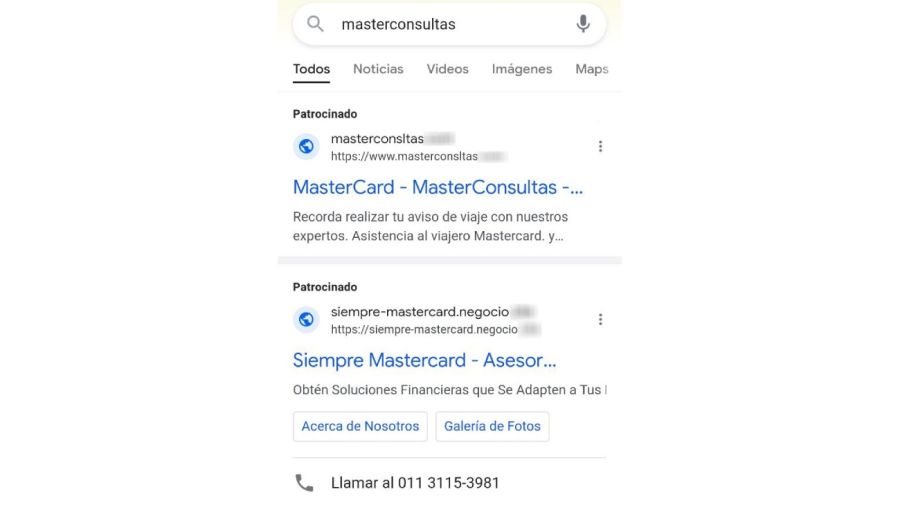
Not long ago, ESET learned of the case of a user who searched Google for a company’s customer service number and accessed one of the first results. Once inside the page, he found that you should leave your contact and, later, a false representative contacted her and explained that she had to upload her billing data into the system as a result of a problem that occurred in the database.
The victim, convinced that an official agent was trafficked, He gave the offender his credit and debit card numbers. Next to the expiration date and security code of ambassadors In addition, the scammer also convinced the woman to send him photos of the front and back of your ID via WhatsApp.
2. Bots and fake profiles
Another common scam that can be seen on social media, especially Instagram and Twitter, is that scammers watch the comments made by users towards companies, seeking, above all, those that present some complaint or claim that warrants a response and resolution by the company or entity.
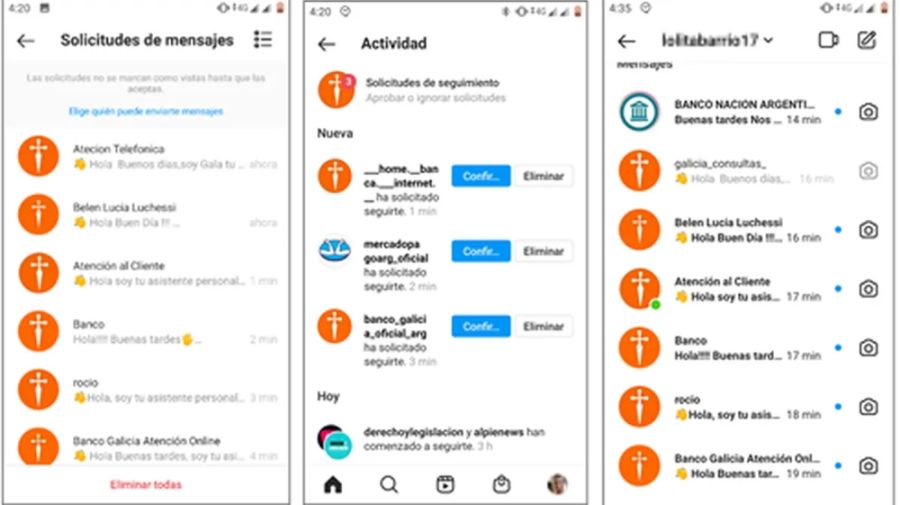
It should be noted that, to carry out the scam, these false profiles have the same logo of the company or entity in question and place a similar or allusive username, seeking to generate credibility. Although in no case do they have verification marks.
After offering assistance to the users, in case they agree, the fake agents contact the victims and request your personal and/or bank details. Even the most organized tend to use robots who monitor the comments of people on networks to detect cases where they could carry out the scam.
3. Fake WhatsApp numbers
Similar to the case of fake social media profiles but via WhatsApp. In these cases, cybercriminals get in touch through the popular messaging application using a profile photo with the logo of the company they are trying to impersonate and a description that makes the number appear to be a legitimate contact.
Once communication with the victim is strengthened, scammers use all the tools at their disposal to convince them to hand over their data. In particular, in this type of crime, cybercriminals are repeated a lot need for immediacy and try to make the person believe that it is a matter of the utmost urgency that they have to resolve yes or yes at the moment, so that they cannot analyze the situation and detect the scam.
4. Vishing, phone calls
He viking is a type of cybercrime based on social engineering that occurs through direct phone calls or voice messages. In these cases, very similar to those carried out on WhatsApp and social networks, the criminals pretend to be official representatives of companies, services or public bodies.
The latest variants of scams that harass WhatsApp users and how to avoid them
One of the main methods that they apply is to contact the clients of financial or banking entities claiming that they want to provide them with the company’s new contact numbers. Later, with the excuse of “validate customer data”try to persuade the victim to share their card numbers.
Where did I get the data from?
In general, cybercriminals access this type of information through databases traded in clandestine forumsThese databases usually include phone numbers, each person’s full name and even card numbers.
The vast majority of these databases reach the internet black market as a result of information leaks suffered by companies, either through direct data theft or by sending malware or installing some other type of malicious code.
AS./fl
You may also like