
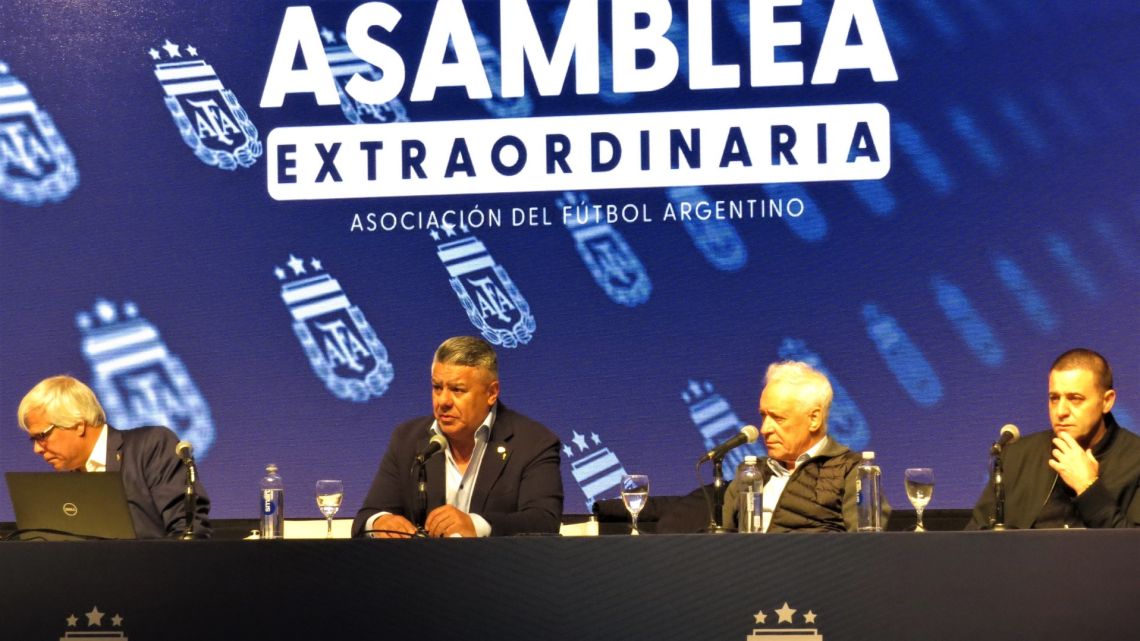

The AFA erased with his elbow what he wrote with his hand. One more time. Eight months after having regulated the three relegations -announced as part of the progressive reduction plan from 28 to 22 teams and the beginning of the end of the averages-, Claudio ‘Chiqui’ Tapia moved the goal in the middle of the game. Forty-five leaders gave him a hand, which they raised without hesitation in the extraordinary assembly on June 22, the national date for Argentine soccer since Diego Maradona scored the best goal in World Cup history against the English. Ball turns.
Without the presence of Talleres, the Assembly of Representatives resolved that there will be two teams that will leave the top division at the end of the year: the one with the worst coefficient of the last three seasons (today it would be Arsenal) and the last one in the 2022 General Table , which adds up to the 27 matches of the Professional League Tournament, currently in dispute, and the 14 matches of the First Phase of the League Cup, which will be played between August and December.
Immediately, the Institute was the great beneficiary. The resolution that Tapia & Asociados took on Thursday afternoon at the Lionel Messi property, allowed ‘la Gloria’ – penultimate in the grid of ratios – to visit River later with the peace of mind of knowing that they were out of the risk zone , regardless of whether they won, tied or lost against the pointer.
The swerve that the AFA gave, right at the halfway curve, also represents a relief for Belgrano, considering its status as a recently promoted team. On the blackboard where the thousandths are listed, a victory can take to the stratosphere and a defeat deposit the casts with an immediate past in the First National at the bottom of the ocean.
Immediately, Instituto was the great beneficiary of the reduction in the quota of descents.
On the eve of the Ezeiza conclave, Diego Dabove and Guillermo Farré, respective coaches of La Gloria and El Pirata, expressed themselves in favor of not changing the rules established before the start of the competition. More ambiguous were the expressions that arose from the leadership state. “The clubs that were promoted last year did not participate in the vote, so I cannot comment. We’ll see what happens. I think the current competition format is good,” said Juan Cavagliatto, head of the red-and-white club.
 WON AND LOST. Week of mixed sensations for the Institute. Relief for being out of relegation and concern for the 1-3 against River. /// PRESS INSTITUTE
go on go on
“As of the 2025 season, the averages will no longer be used as a system to determine the relegations in the First Division Championship,” article 90 of the AFA Statute stated until last week. The regulations set an expiration date for a modality that -except for the cancellation of 2020 and the suspension of 2021, both due to the pandemic- adds 37 seasons of validity in the Argentine soccer elite.
With an ephemeral precedent between the ’50s and ’60s, the amount between points added and games played to settle the permanence was reinstated in Argentine soccer in 1983, under the mandate of Julio Grondona. That time River and Racing de Córdoba (last in the general table) benefited, to the detriment of Racing de Avellaneda and Nueva Chicago.
Only eight times there were coincidences between the worst teams of the season and those in the table of averages: 1986/87 (Temperley and Deportivo Italiano); 1991/92 (Union and Quilmes); 1993/94 (Students and Gymnastics and Shooting); 1994/95 (Mandiyu and Workshops); 1998/99 (Huracán and Platense), 2002/2003 (Unión and Huracán); 2004/2005 (Almagro and Hurricane of Tres Arroyos); 2017/2018 (Temperley, Olimpo, Arsenal and Chacarita).
Since the averages were in force, in 1983, there were 90 relegations and 11 corresponded to Cordovan teams.
In this sense, the great beneficiary of the system was Newells, since it was one of the teams with the lowest harvest in 1992/93, 2006/2007 and 2010/2011, and never lost the category or disputed the instance of the promotion.
Of the 90 relegations to B Nacional that have occurred since the second entry into force of the table of coefficients, and that were distributed among 48 teams, 11 corresponded to Cordovan representatives, according to the following detail: Belgrano (4), Talleres (3 ), Institute (3) and Racing (1).
BELGRANO. He lost the category in 1995/96 (18th in the general table and 19th in averages); 2001/2002 (15th and 20th); 2006/2007 (16th and 19th); and 2018/2019 (22nd overall among 26 teams and with four relegations, and penultimate in the averages). He avoided the four relegations if the sums of the seasons were used, and the second time there would have been castling with Talleres. On the other hand, the thousandths favored him in 2000/2001 and in 2016/2017, and in 1999/2000 he would still have been in the promotion zone.
WORKSHOPS. They were relegated for the first time in 1992/93 together with San Martín de Tucumán, although the worst in the general table were Platense and Newell’s. In 1994/95 he finished last on both grids. In his third and last fall to the B Nacional, in 2003/2004, his successful emblematic case: he finished sixth in the season, in the Copa Sudamericana qualifying zone, but the 17th place in the averages led him to play a revalidation that lost to Argentinos Juniors. The same thing happened to River in 2010/2011: 6th overall, 17th in the thousandths and defeat in the final against Belgrano. Going back to the ‘T’, he was last in 1987/88 and 2001/2002 and was saved by the average. In 2002/2003 he was 15th overall, but 17th place in the relegation table forced him to play a revalidation with San Martín de Mendoza.
INSTITUTE. The 17th place in the averages saved him in the 1988/1989 season, when he was last overall. The following year he last finished on both tables and was relegated. In 1999/2000, the current system hurt him: 15th in the sum, 17th in the thousandths and lost to Almagro. In 2005/2006, he finished penultimate in both rankings.
CAREERS. The average allowed him to get away in 1983, when he was last overall, and in 1985/86, when he finished penultimate in the season. The system punished him in 1987/88 (he finished 17th overall, but had to play a tiebreaker against Unión) and in 1989/90, when he was 18th in the season and lost the category in a one-on-one with Chaco Forever.
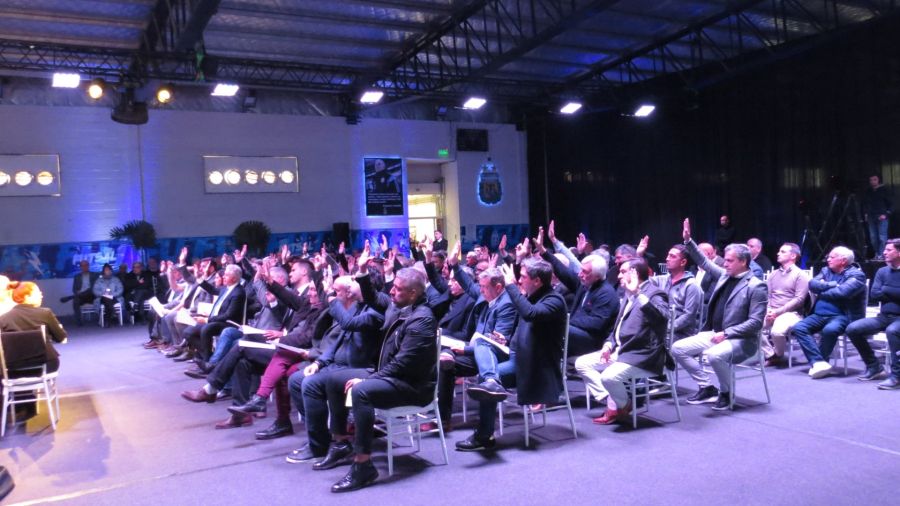 UNANIMOUS RULING. By a show of hands, the 45 assembly members who voted last Thursday in Ezeiza approved the reduction of the relegation quota. /// PHOTO: AFA PRESS
the empty chair
Talleres hit the foul. None of its representatives -1st Vice President Gerardo Moyano Cires (regular) and 3rd Vice President Rodrigo Escribano (alternate)- was present at the Extraordinary Assembly of the AFA that reduced the number of relegations for the Professional League from three to two.
As reported, the decision was made to avoid a potential conflict derived from abstention or expression opposite to the majority opinion, in a vote by show of hands. “They did not want to give them that photo. In the AFA, everyone is very clear about the position of Talleres on the organization of tournaments, ”said a connoisseur of the Albiazul intimacy.
45 representatives participated in the conclave held in Ezeiza: 21 from the Professional League, six from the First National (including the president of Estudiantes de Río Cuarto, Alicio Dagatti), five from the B Metropolitana; two from Primera C, two from Federal A and one from Primera D; in addition to five of the affiliated leagues and three of the ‘Interest Groups’ (women’s soccer, futsal, beach soccer, former referees, former coaches and ex-soccer players).
Apart from Talleres, which decided not to participate, six other First Division clubs were left out of the election: Belgrano and Instituto, because they were recently promoted, and Tigre, Barracas Central, Sarmiento and Godoy Cruz.


