


From the private sphere, they propose to advance with agreements between the public sector to promote the local development of companies, with new jobs, in bioeconomic activity in Argentina and improve local agricultural and livestock performance.
As expressed Alfredo Paseyro, executive director of the Argentine Seed Growers Association (ASA) In dialogue with Aire de Campo, the need to generate policies to promote biotechnological innovation in Argentina, and in all activities related to the bioeconomy, raises -just like experts- promote multiple instruments to improve the productive matrix, generate more value added to the production of grains and raw materials, and stimulate local scientific and technological knowledge. In addition to stimulating private investment in fields linked to agricultural production.
These topics were analyzed and exposed by specialists in the Ibero-American Congress of Knowledge Production and Economy 2023, where the participants agreed on the need to have stable and long-term policies to achieve these development goals. The objective is to meet a demanding global demand for food.
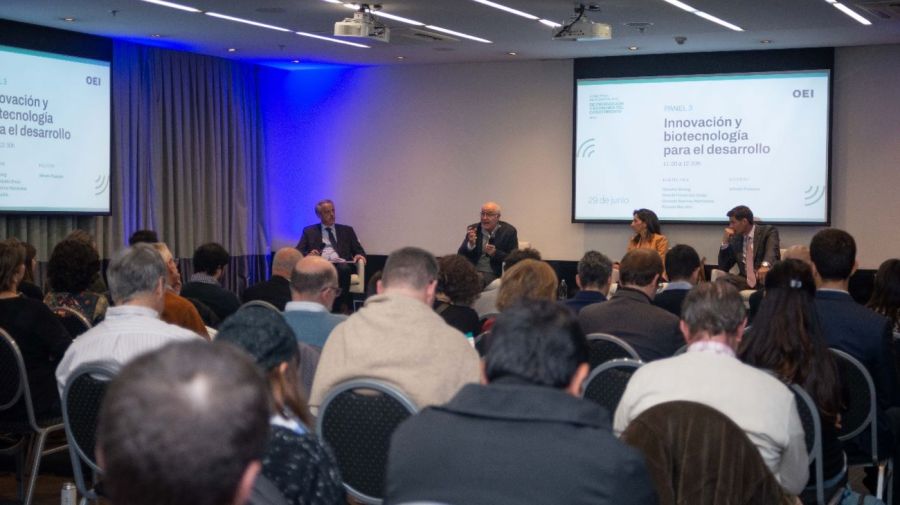
Paseyro stated that “applied innovation with scientifically based knowledge is a reality and is the future for the development of Argentina” and stated that “the large investments” promoted by biotech companies require “public policies that offer predictability. You have to educate to plan State policies, and thus be able to apply green chemistry”.
Among the speakers, Roberto Bisang, Professor of Economics at the Faculty of Economic Sciences from the University of Buenos Aires, stated that “the world, which changed at an impressive speed, began to think that natural resources are finite and that you have to go for renewables. There biotechnology appears as the key to make the industrial transformation, converging the electronic with the technological, converting material resources into energy”.
He added that “the new world model is based on renewable energy and biomass, and in Argentina there is an applied biology base that has now been revalued. We have a business setup in food and genetics that implies the possibility of being slightly optimistic in the future ”, she assured.
The UNC chose its most innovative projects
On the other hand, Natalia Fernández Eraso, head of Bayer’s Regulatory Sciences area for the Southern Conepondered the “impact” that the development of biotechnological products has on today’s society, and for this reason he thought that “agrobiotechnology has positioned Argentina in a leading role: the seed is the main input but innovation in agriculture is also it has to do with sustainability and with the new challenges generated by climatic conditions.”
Fernández Eraso also explained that “a new technology that is coming is gene editing, a tool that allows editing the genome of crops, microorganisms and animals. That gives Argentina a huge opportunity. The limitation is the international context, in the future it is something that must be worked on”.
In his presentation, he also stated that the local seed industry hires 4% of the scientists who do research in the country, and also allocates 9% of its annual turnover to research and development of new products and activities. He highlighted that thanks to the research work carried out at the local level, consolidated with the creation in 1991 of the National Biotechnology Commission (CONABIA), a reference for FAO, there are already 70 biotechnological events that have the seal of the country, in the case of soybeans, corn, wheat and alfalfa, among other products.
Also Gonzalo Ramírez Martiarena, former Global CEO of Louis Dreyfus and founder of Swiss PampaHe urged to take into account the work that must be done in the future: “I would like to focus on the possibilities that we have in the next twenty-five years: thinking of a static world is a mistake.”
After highlighting the opportunity provided by analyzing issues such as “sustainability” when producing grains and raw materialsRamirez Martiarena He explained that “regenerative agriculture allows better carbon capture and today carbon capture certificates are key to generating new agreements with companies. Today the world is crying out to switch to renewable energy and in Argentina we can produce much more ethanol and biodiesel”.
“Public policies must be discussed hand in hand with the private sector at international tables because we need support to develop globally,” said the specialist now based in Switzerland.


