


The possibility of accessing abortion in safe conditions is an issue that generates divisions in public opinion in the midst of a global context of economic crisis and the rise of extremist political positions. Attitudes towards this right vary from region to region and within countries, and are conditioned by factors such as religion or party affiliation.
According to World Health Organization, safe abortion care “is essential to protecting the health of women and girls around the world.” The declaration of the UN dependent body after the decision of the United States Supreme Court to annul the historic Roe versus Wade ruling that legalized that right and shook the map of the progress of the legalization of abortion in the world last year.

The United States Supreme Court ruled that abortion is not a constitutional right
In that context, the american institute Pew Research Center updated the index based on research on 24 countries to account for the most relevant facts about the state of the right to abortion worldwide.
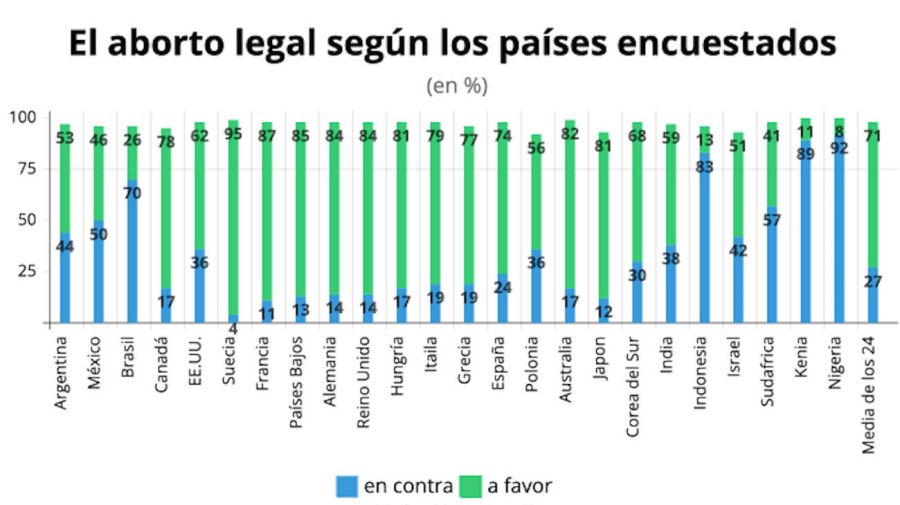
Although it increases that the majority of those surveyed “They support legal abortion” in almost all countries, other underlying reasons behind reluctance such as religion or party affiliation stand out. From the strong legalist tradition of Europe to the unprecedented cases of Poland, India, Brazil or Japan, these are the 5 paradigmatic data on abortion worldwide:
1. Poland, the exception to the European rule
In Europe there is a general agreement close to 75% of the countries surveyed that assured that abortion should be legal, while approximately 25% stated that it should be legal in all the cases. Swedes are especially understanding: 95% say it should be legal in all or most cases, including 66% who say it should be legal in all the cases.
On the other side is Poland, whose inhabitants hold more restrictive views, considering that more than half of Poles (56%) say that abortion should be legal in all or most cases, while 36% say that It should be illegal in all or most cases.
2. After Indonesia and Nigeria, Brazil is the most restrictive
Brazilone of the most thriving economies in the world, has one of the most restrictive rules of the countries surveyed, which also agrees with the general vision of public opinion regarding abortion, considering that seven out of ten adults say that abortion should be illegal everywhere or in the most cases.
This percentage distances the South American giant from its regional neighbors, Argentina and Mexico, and places it close to countries such as Indonesia, where 83% of adults say it should be illegal in all or most cases; either Nigeriawhere the condemnation of legal abortion rises to 92%.
Meanwhile, abortion rules are more restrictive in countries where support for legal abortion tends to be lower. Abortions in Brazil, Indonesia and Nigeria are only allowed when a woman’s life is at risk.
The feminist struggle against obscurantism and reason against myths
3. Religion and the case of India
Attitudes toward abortion are strongly tied to the importance people say religion has in their lives. In countries where a higher proportion of people say that religion is an important factor, this is consistent with the rejection of legal abortion, as in Nigeria or Sweden.
An outlier, however, is India, where 94% of Indians consider religion important, but 59% also support legal abortion.

4. The case of Japan
Attitudes about legal abortion vary in the Asia-Pacific region. In Australia, India, Japan, and South Korea, the majority spoke in favor of legalizing abortion in all or most cases.
In the Japanese case, 81% were in favor of this premise, despite the fact that this social change is not consistent with the demands for gender inclusion that prevails in that country, the only one of the G7 where equal marriage continues to be illegal. and where women need permission from their partner to abort.
5. The socioeconomic factor
Economic development also plays a role in the bias in favor of legalization. In countries with lower GDP per capita, people tend to be more religious and have more restrictive attitudes about abortion.
cd/ds


