
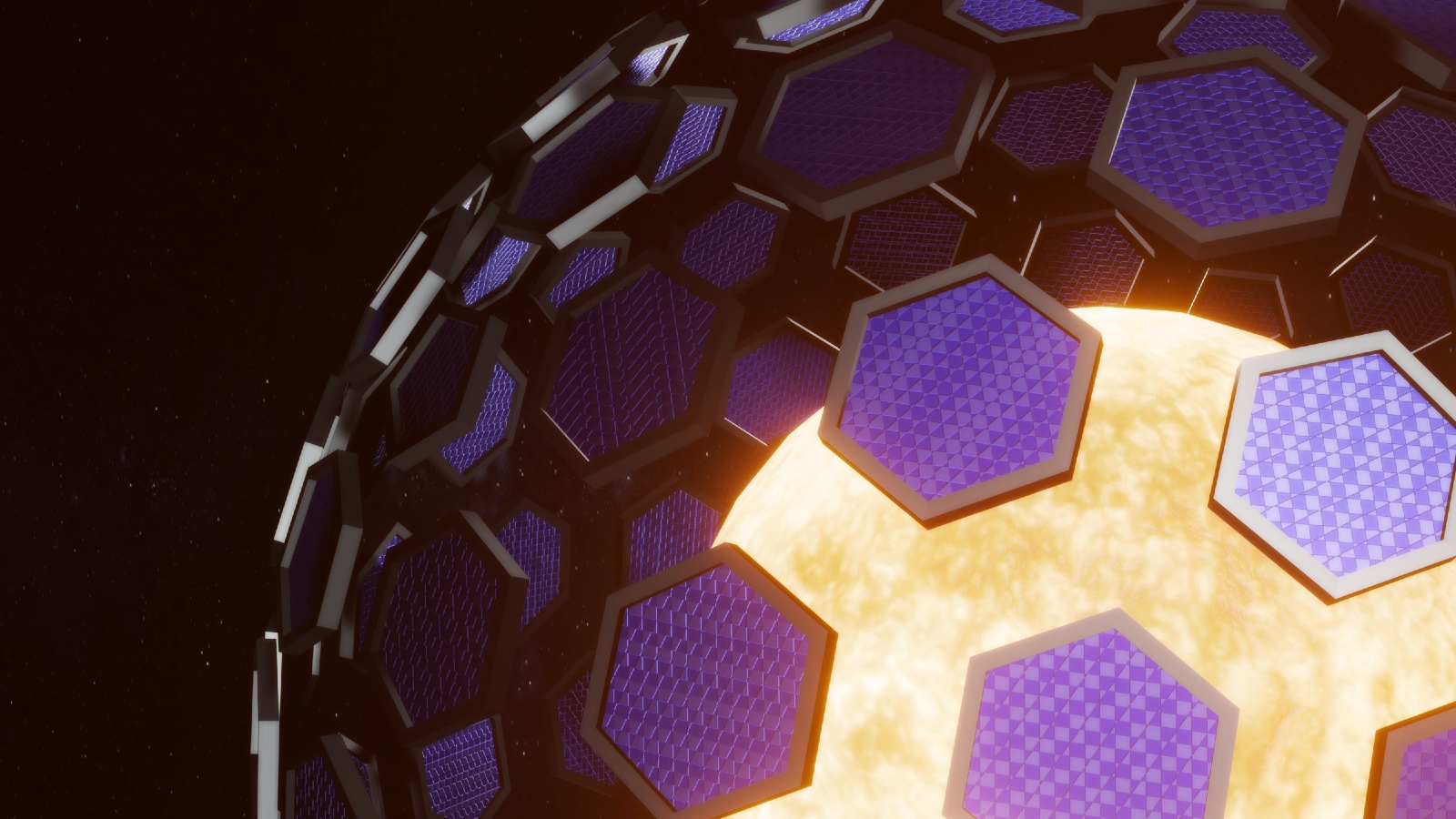

Astronomers have identified strange energy patterns emanating from several faraway stars, which might be the first possible indications of theoretical megastructures called Dyson spheres. These enigmatic discoveries, recorded by numerous observatories, have renewed scientific curiosity in the quest for extraterrestrial intelligence via non-traditional methods.
The concept of Dyson spheres originated in 1960 when physicist Freeman Dyson proposed that sufficiently advanced civilizations might construct enormous energy-collecting structures around their host stars. These theoretical megastructures would allow a species to harness nearly all of a star’s energy output, potentially leaving detectable traces in the form of unusual infrared radiation patterns. Recent surveys have identified at least seven main-sequence stars exhibiting exactly these predicted characteristics, with no conventional astrophysical explanation readily available.
Researchers employed a novel analysis technique combining data from the Gaia satellite, the Wide-field Infrared Survey Explorer (WISE), and the ground-based infrared telescope network. They focused on identifying stars that emit unexpectedly high levels of mid-infrared radiation without corresponding visual light patterns—precisely the signature Dyson theorized might indicate artificial structures. The candidate stars, all located within 1,000 light-years of Earth, show thermal profiles inconsistent with known natural phenomena like dust clouds or protoplanetary disks.
El equipo subrayó la necesidad de ser cuidadosos al interpretar estos hallazgos iniciales. La investigadora principal, la Dra. Gabriella Contardo de la International School for Advanced Studies, señaló: “Aunque estos objetos coinciden con algunas predicciones teóricas sobre las esferas de Dyson, debemos agotar todas las explicaciones naturales posibles antes de considerar un origen artificial”. Las hipótesis alternativas incluyen distribuciones inusuales de materiales circumestelares o etapas de evolución estelar no observadas anteriormente.
Esta investigación constituye un avance importante en la búsqueda de inteligencia extraterrestre (SETI). Las iniciativas tradicionales de SETI se concentraban en la detección de señales de radio, mientras que las técnicas más recientes analizan datos astronómicos en busca de indicios tecnológicos, que son evidencia física de ingeniería a escalas cósmicas. El presente estudio es una de las tentativas más sistemáticas de emplear este enfoque de “tecnofirmas” en datos de observación ya existentes.
The candidate stars share several intriguing characteristics. All are main-sequence stars similar to our Sun in size and temperature, making them theoretically suitable for life as we understand it. Their infrared excess emissions remain stable over time, unlike the variable patterns typically produced by natural dust formations. Most remarkably, several show unexpected dips in visible light output that could suggest partial obstruction by solid structures.
Astrophysicists have proposed multiple follow-up studies to investigate these anomalies further. Planned observations include high-resolution spectroscopy to analyze the chemical composition of the infrared-emitting material and searches for laser communications or other artificial signals from these systems. The James Webb Space Telescope’s powerful infrared instruments may provide crucial additional data in coming months.
The possible discovery has ignited a lively discussion among scientists. Some detractors insist that proposing extraterrestrial megastructures goes against the rule of favoring natural explanations unless absolutely required. On the other hand, proponents argue that thoroughly ruling out all standard explanations is an essential part of the scientific method, and certain occurrences might indeed demand non-traditional solutions.
Beyond the immediate astronomical implications, these findings could profoundly impact our understanding of humanity’s place in the universe. Confirmation of even one artificial megastructure would suggest that technological civilizations capable of stellar engineering not only exist but may be relatively common in our galactic neighborhood. This would dramatically alter calculations in the Drake Equation, which estimates the number of detectable civilizations in our galaxy.
The research team plans to expand their survey to include more stars and additional wavelength ranges. They’re also developing more sophisticated models to better distinguish between possible natural and artificial origins of infrared excesses. As observational technology improves, scientists may gain clearer insights into these mysterious objects—whether they represent unprecedented natural phenomena or humanity’s first glimpse of an alien civilization’s engineering prowess.
For now, the scientific community maintains cautious optimism. As Dr. Contardo summarized, “We’ve found something genuinely puzzling that merits further study. Whether it’s ultimately explained by new physics or new civilizations, we’re pushing the boundaries of what we know about the universe.” This measured approach reflects the growing maturity of SETI as a scientific discipline, balancing open-minded investigation with rigorous skepticism.
In the years ahead, it might be decided if these unusual stars signify a significant advancement in astrobiology or if they merely belong to a fascinating new category of astrophysical bodies. Regardless of the result, it is sure to enhance our comprehension of the universe and our role in it, furthering humanity’s timeless pursuit to uncover if we are solitary in the cosmos.