
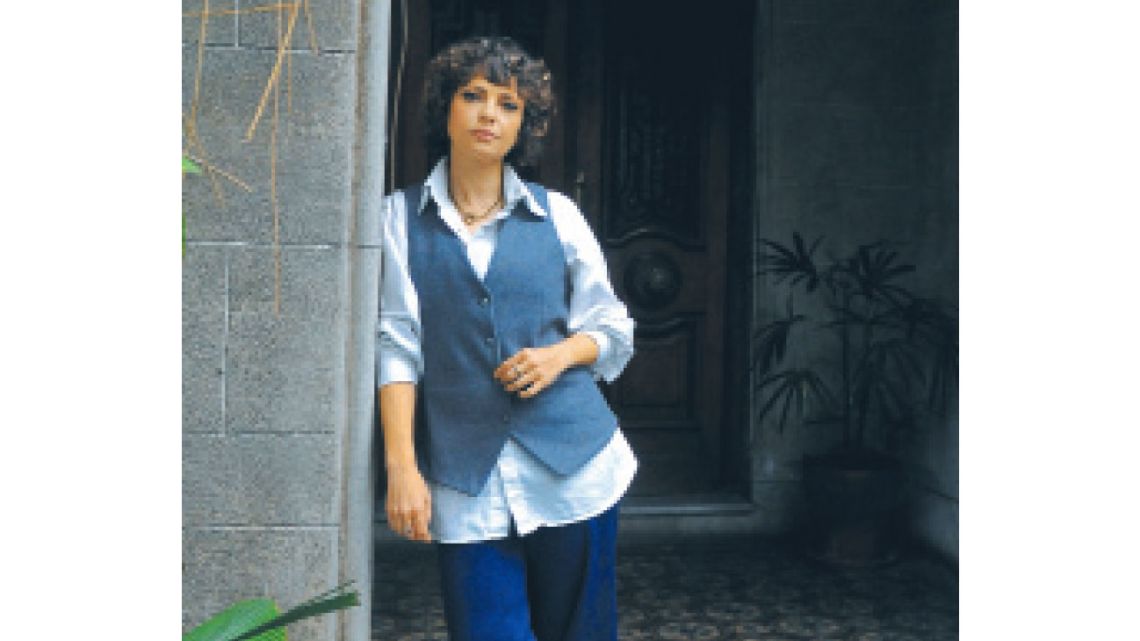

Her face, like her last name, Fonzi, is immediately associated with acting, but the eldest of the three siblings –Tomás and Diego- is Dolores, and she is the one who makes her debut as a director with her debut feature Blondi. The film hits theaters from June 1 and will later become part of the Prime Video offer. At the last Bafici, where she saw her national premiere, she received the cast award for Best Performance (in the framework of the Official Competition) and the Best Argentine Director among all official competitions (DAC Genre Award). At the time of this film, she assumed the task of writing the script together with Laura Paredes and she herself leads the cast along with Carla Peterson, Rita Cortese, Leonardo Sbaraglia and Toto Rovito.
—You filmed it in 2022, but how did you put together your debut film?
— The script was first developed with Santiago Mitre, after having read a novel where the image of a mother’s relationship with her son prevailed. It made me want to work on that idea, it was he who would determine that I should co-write with Laura Paredes, whom I admire and she is my friend. We started working in 2017. We wanted it to be a comedy, because I felt more protected. The script had a thousand instances, it mutated until it became what it is. It was finally captured on set. We did not improvise, but played what had to be established at the time of the scene.
—Were you clear on the tone of comedy?
—I like to laugh at reality, at myself and at others, and comedy allows you that. For now it is the only way to communicate. I think it’s light but not that much, I feel like it touches on many issues, but it doesn’t theorize, it raises them. The film resembles my ideal. Take life seriously but not suffer it, because at the end of the day we are going to die. I didn’t set out to have fun, but I worked the material little by little. Everything was very handmade. I represent You cannot make a film thinking about how people will receive it. I think about what I like.
—How to choose the places: Luján and the province of San Luis?
—The locations have a lot to do with what can be done at the time of filming. You have to adapt and add what you want and seek. Luján was the only hotel that he will use nearby to be able to shoot for a few weeks. San Luis appeared hand in hand with Rita (Cortese), since she knew someone from the province’s Ministry of Culture and she facilitated us. We found the house where my protagonist lives with her son in the Liniers neighborhood: I liked that corner with her balcony.
—Did you hesitate until you formed that fictitious family?
-No. Toto Rovito, who plays Mirko -my son- is the grandson of Bárbara Mujica and Gabriel Rovito, and the son of Pablo, a film producer. I met him on the set of Argentina 1985 and I liked that he was very different from me, so that the viewer would think what the father would have been like. I’ve known Carla (Peterson) since the summer of ’98 and I always had her as a possibility to play my sister. And Rita (Cortese), as well as being a great actress, was “the” mother for me, I had no doubts.
—Among the thanks that appear from Carolina Fal, the Colectivo Actrices Argentinas to Gauchito Gil: why?
—With Carolina (Fal) we have been friends for many years and I am even the godmother of her eldest daughter. She always accompanies me, she saw it and liked it. She is part of my first adulthood, my reference. For me, having found Actrices Argentinas was like a very important refuge. I thank you all. Some have already seen the movie. They understand and accompany you, it is to have a circle of belonging, they put the body, which nobody does. It is the producer, La Unión de los Ríos with Agustina Llambi Campbell who always thank Gauchito Gil, also appears in La patota and in Argentina 1985.
—How much of your personality is there in this protagonist?
—It is not autobiographical, but self-referential. For example, the poem by Gustavo Adolfo Bécquer that Rita recites to her grandson was always told to me by my grandmother. There is a scene in which they talk about “diamond” and play with long names: it’s something I do with my daughter…
—The film La patota: was it a before and after in your career?
-Completely. Because something happened to me with motherhood. I had two children very closely, for which I was almost without work and raising them. When the possibility of filming La patota appeared, it was a balm, to be able to return to acting, get stuck in a story, read many books and enter that world. I felt that having been a mother, I no longer had anything to lose. I felt more planted in life. Motherhood for me was very strong. Today my son Lázaro is 14 and Libertad is 12 years old.
—Recently Blondi appeared at Bafici: what balance do you make?
-It was beautiful. First I felt relief, as the outside look was approving. The film protects me. I feel that making films is a collective act. It is impossible to film without a team of people. The protagonist – Blondi – does not move away from the others, on the contrary. I’m proud of this movie, I feel like everything I gave to make it is coming back. It seems to me that it turned out quite well and that it allows to bring topics on a table.
—How much of your own relationship with your brothers is there in this fiction?
—When the ties are as intimate as those between siblings, it allows you a flexibility that goes from maximum tranquility to exacerbating you, that is, from zero to a thousand. I think it happens with all the brothers, you never get resentful. You can fight, argue, criticize, but when you have to be, there you are.
—How did you receive the opinion on the trial of Thelma Fardin against Juan Darthés?
I didn’t expect it, but it doesn’t surprise me. Justice is quite unfair in general. It was to be expected, things never go well. Statistics tell us that this happens in cases of reporting abuse and harassment. I trust Thelma, she is a person who works, reflects, thinks and does not stop. Which is not just for her, but for all those who come after her. Admiration and company as I can. I hope justice is done.
—What project after this premiere?
—Digesting is difficult, you have to sustain an idea over time. I’m going to see what happens with the premiere, then see a script… I like people to see it in the cinema, so that they have the greatest access.
—To what reflection does the current situation of INCAA lead you?
-We are in problems. We’ve been bad for quite some time. In fact, my film could not have been filmed during the macrismo, since the Law on First Films took it out and you had to enter a contest. It’s like the issue of subsidies had been commercialized and they gave it only to films that could be big, that is, a business. We should stop skimping and not belittle culture. It is terrible that he submits to the cinema, when he pays for himself. You must think about the common good. Our movies compete with a million dollar theater.
Between cooking and music: always acting
Cinema not only excites Dolores Fonzi as a creator and protagonist of fiction, but also as a spectator. She left a sweet taste when she participated in the movie Distancia de rescate on the novel by the Argentine writer Samanta Schweblin that she directed to the Peruvian Claudia Llosa. She can still be seen on the Netflix platform along with María Valverde and Germán Palacio.
In pandemic times, the other side of the Fonzi became known: culinary art. Both his brother Tomás de él, as well as the sporadic appearances of his mother, in Master Chef confirmed it. Dolores reflects: “When you have children, for me cooking is a race against time, especially taking health into account. Santiago (Mitre, her partner) cooks much more than me, he makes barbecues and fires. I come from a family that everyone cooks. Music also unites us a lot, at one point the three of us wanted to have a band but we didn’t make it”.
He remembers who his great teacher was: Carlos Gandolfo and underlines: “I had theater teachers, but he was the definitive one. He always said that he was looking to make particular actors. His classes were very mobilizing. He was an awakening in acting. He was an amazing teacher”.
“I like working with friends and having free time. Leisure to inspire me. I don’t have great claims. I would like to work with Lucrecia Martel, with whom I never filmed. When you grow up you learn to be happy with what you have. While filming Blondi I was happy all the time. I enjoy the little things in life. I have two children, two dogs, two cats and two fish. I like to take care of, ”she concludes.
You may also like


