
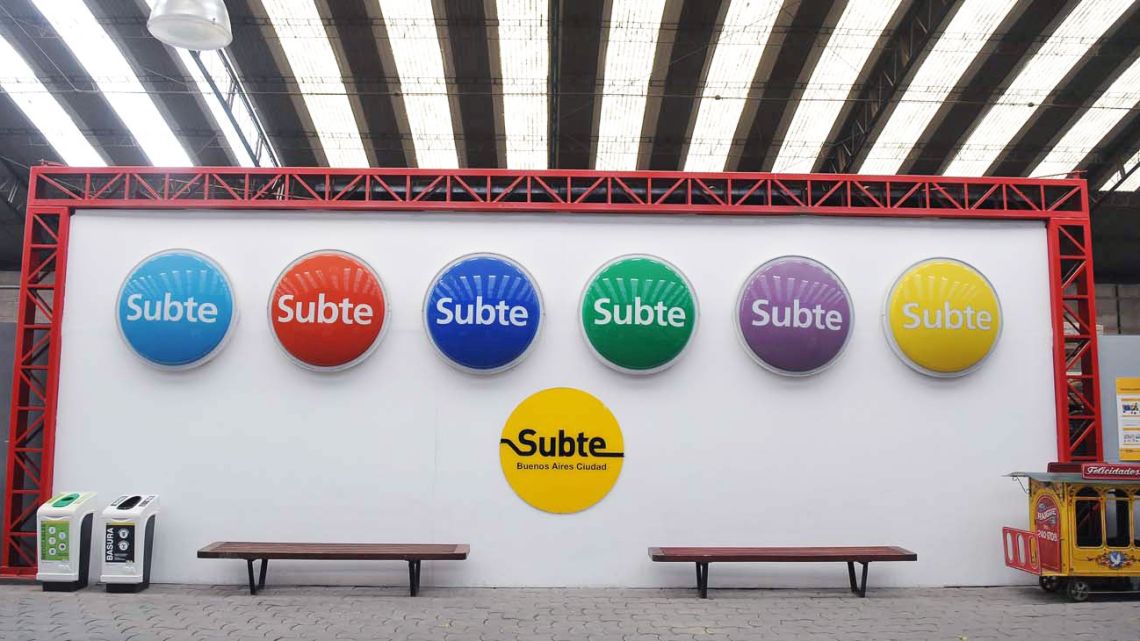

A few months before turning 110 years of service, which will be celebrated on December 1, the Buenos Aires subway opened the doors of its Centenera Heritage Laboratory to PROFILE. This place is a space dedicated to the storage, restoration and dissemination of the different elements that have been part of the Buenos Aires subway network since its origins, and that have been rescued since 2008.
The museum is located in a sector of the Polvorín Workshop of this public transport system, on Del Barco Centenera street, a few meters from Directorio. It is a place that was built with recycled materials from the subway network itself, reusing the industrial surplus generated by the service. According to what was explained by Subterráneos de Buenos Aires (Sbase), this project could be carried out after applying, in 2020, to a call for cultural patronage, together with the Friends of the Tram Association, in order to receive: financing, for this first stage, two million five hundred thousand pesos.
According to Sbase sources, the workshop was built between 1978 and 1989, and was used to store items from the subway network workshops. The building is cataloged with the level of Structural Protection established by Law 2,796 of the Urban Planning Code.
In the place, which occupies about 1,250 m2, visitors can find everything from a 1912 Preston car, which was part of the only English formation on Line A when it began a circular route before the wooden formations of La Brogeoise (the Witches); a wooden change control and signal table for Line C; weight and height scales almost a century old that were found on some of the platforms of lines A and C. Also blanks and turnstiles that were used to access the platforms before the SUBE cards, original signage for each line; furniture from the different stations of the Buenos Aires subway service and even the first wagon that the Quilmes company brought to distribute its beer.
In addition, there is a 10 m2 auditorium, original plans of the network and the original ceramics that are part of the different station murals. Many of these majolicas are still stored in the original drawers that arrived in the country by sea at the beginning of the last century.
In the same space, specially conditioned for the occasion, there are also the ceramics that were removed from the platforms of the Carlos Pellegrini Station (Line B) to the Diagonal Norte Station (Line C) through the 9 de Julio Station ( Line D) for the construction of the future Obelisk Node. After their removal from the walls, the majolicas of line C were conditioned for their transfer by experts and placed under protection in the Laboratory.
This space includes a sector for ovens and a warehouse for finished pieces. At the same time, work will be done on the assembly and design of a heritage map of the intervened stations, preparing a matrix of each piece with the identification of its components. In this way it will be possible, before a possible intervention, to know what are the necessary elements for its improvement and should.
At the entrance to the workshop, and following an agreement with the Friends of the Tram Association, two cars from the Citadis tram, which used to run the length of Puerto Madero from end to end, are also to be restored and valued (see separate).
Beyond the variety of clocks, pressure gauges, tunnel telephones, signage and service memorabilia, one of the must-sees of the restoration workshop is the area where there are more than 50,000 original plans, both cloth and paper, since the beginning of the network.
These documents were found frozen at a temperature of -20ºC since 2010 and little by little they are being recovered. As explained in the place, they were frozen in order to protect them since they got wet as a result of the flooding of the basement in which they were found deposited. According to specialists, freezing was the best way to preserve them, since in this way their destruction (which will become a mass) is avoided and they will be completely lost. They are located in a place of about 50 m2 designed specifically for their treatment. They are defrosting according to the guidelines indicated by the General Directorate of Heritage and Historical Center of the Ministry of Culture of the City to preserve them. At present, it is working on provisional storage until its restoration and final storage.
The purpose of this action is that once recovered they can be reference material both digitally and physically, becoming part of the Sbase archive again.
Heritage
◆ The Laboratory is located at 777 Del Barco Centenera street, Directorio corner, in the Caballito neighborhood.
◆ You can visit the last Saturday of each month, from 4 to 7 p.m.
◆ In this place you can find everything from old cars to the 50,000 original plans of the subway network.
◆ Some 1,600 elements found in the different subway service lines were reused.
The Puerto Madero tram
As soon as the visitor recovers the first meters from the Centenera Heritage Laboratory entrance, two Citatis cars appear in the exterior scenery of the restoration and recovery workshops.
These are the cars that were part of the Puerto Madero Tram, which ran along the entire length of Puerto Madero from Dock 1 to Dock 4, parallel to Alicia Moreau de Justo and Eduardo Madero avenues. The train traveled only 16 blocks and was used by an average of 25 people per day.
The formation stopped working in October 2012 and the cars were left to fend for themselves. There they were graffitied and vandalized since they were barely protected by gray tarpaulins. After being rescued by Sbase and together with the Friends of the Tram Association, they are currently evaluating turning them into a cultural space or even considering the possibility of putting together an educational tour, as happened with the Polvorín Workshop Tram.
One of the cars found in the heritage workshop is the red Citadis 302, manufactured by the French company Alstom, baptized by the Ministry of Transportation as Celeris.
You may also like


