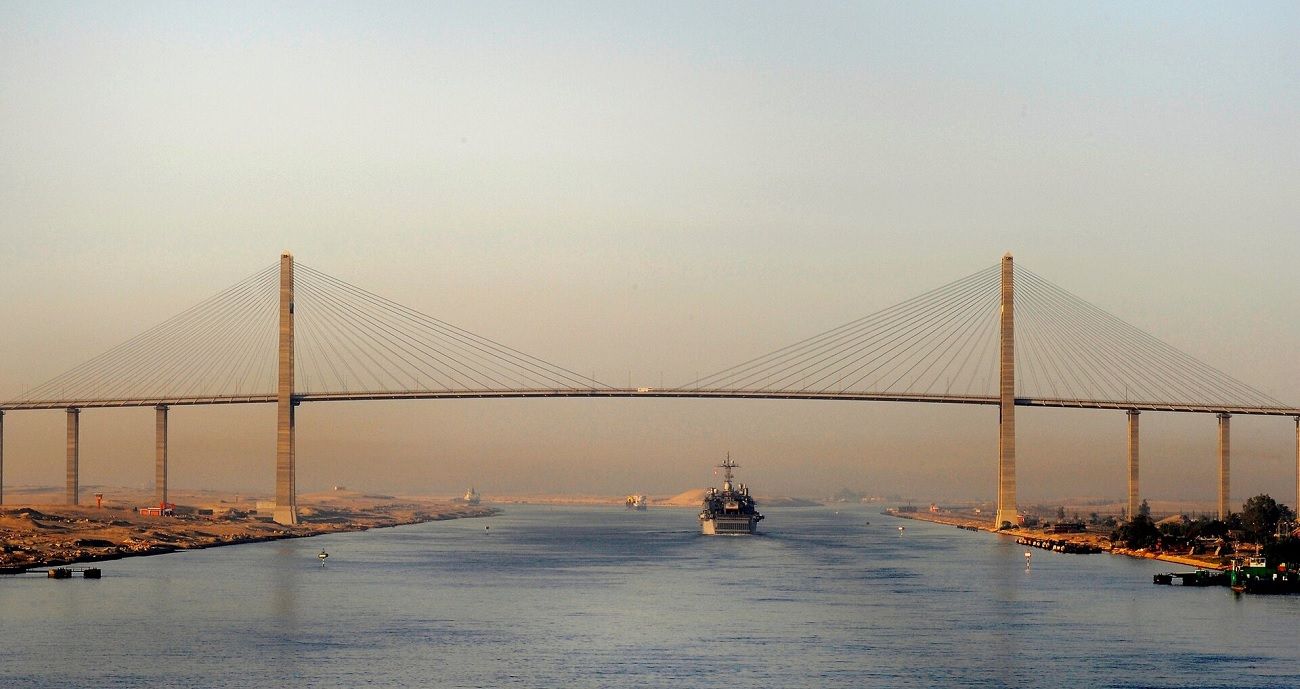

If we take a globe and look at the extreme northeast of the African continent, where it joins the Arabian peninsula, we find a geographical peculiarity. The waters of the Mediterranean Sea are very close to those of the Red Sea. This closeness, separated by just 150 km from the mainland, is not a whim of nature.
The earth’s surface is not still, as common sense sometimes would have us believe. We spend our entire lives walking on tectonic plates that move, if only a few millimeters a year, but they do. In this displacement many times these plates collide with each other, and some even sink below others that ignite in this transit earthquakes. Likewise, in other parts of the planet, a new earth’s crust is generated, separating a tectonic plate in two, as has happened for millions of years, for example, between South America and Africa. Hence, like a puzzle, we can perfectly fit the coasts facing both continents if we ignore the Atlantic Ocean. In this case, common sense does not fail.
Returning now to that area where the Red Sea almost touches the Mediterranean Sea, we discover that the earth’s crust has already begun to crack there and in the future there will be no continental contact between Africa and Arabia. And just like the Atlantic in the previous case, the sea that will separate them already exists and it is precisely the Red Sea. But don’t worry, there are still millions of years to go before those last 150 km of mainland that still unite both sides disappear.
But of course, many times we are anxious and we want things to happen right now. And if there is also a revenue from the commercial, that anxiety escalates. That is why since ancient times the human being has wanted to unite these two bodies of water fluvially. And it is not for less: if such a thing existed, the ships that wanted to go from Europe to Asia and vice versa, would save having to circumnavigate Africa.
The first known attempts at this test date from the time of the pharaohs 4,000 years ago. By then the Egyptians were satisfied that simpler than making a canal linking the two seas was to join the Red Sea with the nearest Nile River and that since the river eventually empties into the Mediterranean Sea, it did the rest of the job. That first union was called the channel of the pharaohs, and shields for hundreds of years, but at some point in history it fell into disuse when it was buried by great sand storms that came from the desert.
Although it is known that in earlier times, both the Romans, the Venetians and the Ottomans wanted to rebuild a canal, it was just Napoleon Bonaparte who took action on the matter. In his 1798 foray into Egypt he became so interested in the project that he sent surveyors to ascertain the heights of the waters of both seas. That was not a minor fact, since if there was much difference between them, not only a canal had to be built, but also locks to allow ships to navigate. When the surveyors informed him that there were about 10 meters of difference, Napoleon turned around and returned to Europe since he had other more urgent interests such as being proclaimed emperor shortly after.
Although the Frenchman never knew it, the surveyors got their calculations wrong and the reality was that both mares were almost at the same height. Finally, it was another countryman, named Ferdinand de Lesseps, who in 1859 faced the construction of the long-awaited canal and would call it “Suez” given the homonymous city near the southern entrance, on the Red Sea. Of course, the ships in the mid-19th century were already much larger than those that had ever passed through the channel of the pharaohs 4,000 years ago. For this reason, a much deeper canal had to be designed and one that would no longer use the Nile River. With a North-South layout, it would directly connect the Mediterranean Sea with the Red Sea.
For 10 years, Ferdinand de Lesseps watched as more than 25,000 people dug the canal with their bare hands, stirring up the sand. When they found out in Europe that slaves were doing that work, such an international scandal was created that Lesseps was forced to pay each one and also buy steam machinery for the most laborious jobs. Finally, in 1869 the 163 km linking both seas were ready and the Suez Canal was inaugurated. The main beneficiaries of the use of the canal at that time were the English who were then at the height of their exploitation of India.
Today, up to 100 ships per day pass through the Suez Canal, linking Asia with Europe, saving 15 days of navigation around Africa. Of course, this benefit has a price; a bulk carrier, for example, must pay out 250,000 dollars each time it crosses it in any of its directions.
by Esteban Nigro
image gallery