
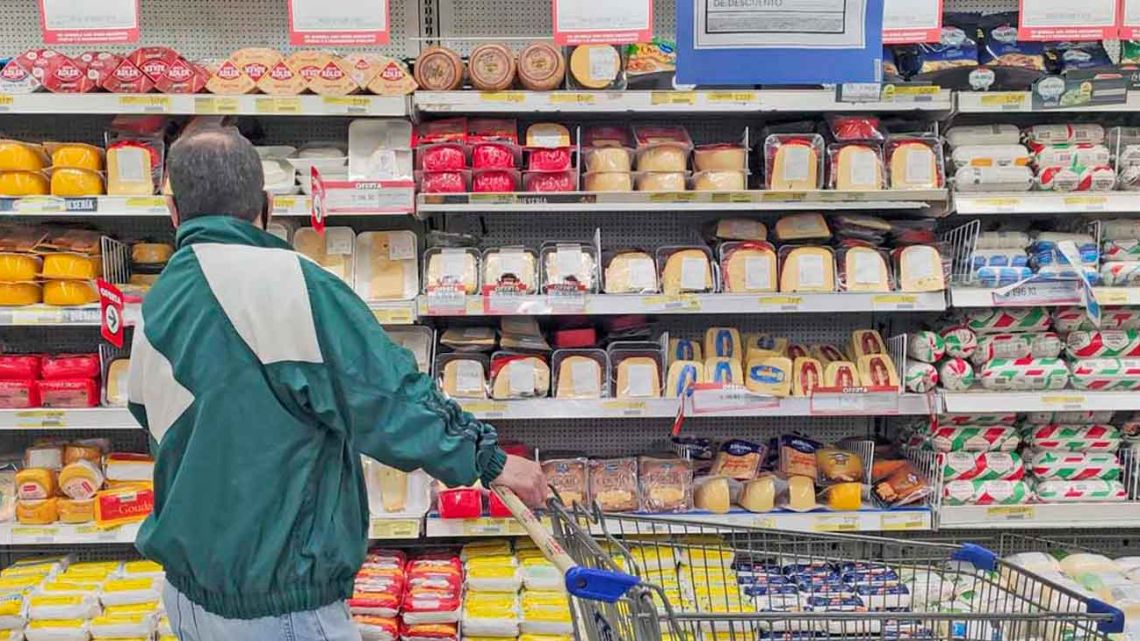

Consumers are more in debt and can therefore buy less and less.
Credit card transactions grew 120% year-on-year in supermarkets, but the average ticket climbed well below inflation, 89.6% between January and April, according to INDEC.
In total, a person spends an average of $5,022 each time they go shopping, an amount that is enough for an increasingly smaller variety of products, according to a survey by PROFILE.
The options for using that average ticket are various, but progressively more limited. The amount is enough to buy, for example, a package of 36 diapers, a package of rice and a sachet of milk.
In cleaning products you can buy, with that amount, 1 conditioner, 1 shampoo, a package for three toilet soaps, 1 liter of bleach, 1 detergent and a package of powdered laundry soap for 3 kilos.
In basic foods, if offers are found, the option with $5,022 is to buy 1 package of noodles, 1 sachet of milk, 1 package of common flour, 1 dozen eggs, 1 kilo of sugar, 1 kilo of ground meat and 1 package of rice.
However, according to INDEC, while supermarket sales grew by 3.4% in general terms in April 2023 compared to the same month last year, in wholesalers the percentage growth was 7.3%. In the latter case, credit card sales grew 182%, while the average ticket grew 49% in one year, reaching 11,007 pesos, with which the ticket growth continues to be well below the level of indebtedness.
Most of this amount was allocated to “clothing, footwear and home textiles”, which grew 377.9% compared to the same month in 2022, “electronics and household items” (184.5%); greengrocers and greengrocers (160.5%); meats, (155.9%); and “dairy”, 143.3%.
Wholesalers consulted by PROFILE assured that, although they noticed a greater turnout of consumers, this is not reflected proportionally in the billing. “More people come, but the purchases are smaller” and sales are concentrated in basic necessities, such as oil, flour, sugar, grass, rice, noodles, tomato puree or some particular offer. “Some bought by pack but you see many more cars with small purchases,” they detailed. They also noticed an increase in credit card sales in one payment, although installment sales also appear when promotions are found.
The merchants added that consumers pay more attention to price, but that purchase levels have dropped and consumption habits have changed a lot compared to the pandemic, when consumers bought in quantity to save.
Juan Vasco Martínez, executive director of the Association of United Supermarkets (ASU), assured PERFIL that the sector does not see a decrease in sales compared to wholesalers. In fact, according to his own verifications, sales in supermarkets grew, in comparison, “by 2.9% so far this year.” ASU performs its statistics in a joint effort with the consultants. “The situation is still good in terms of sales volume, we have gained market share,” said Martínez. “It grew because there is a 30% price differential in the basket comparable to self-service stores,” he summarized.
The wholesalers, on the other hand, say that they receive more people “but we are not exploding in sales”, purchases have been reduced to what is strictly necessary.


