
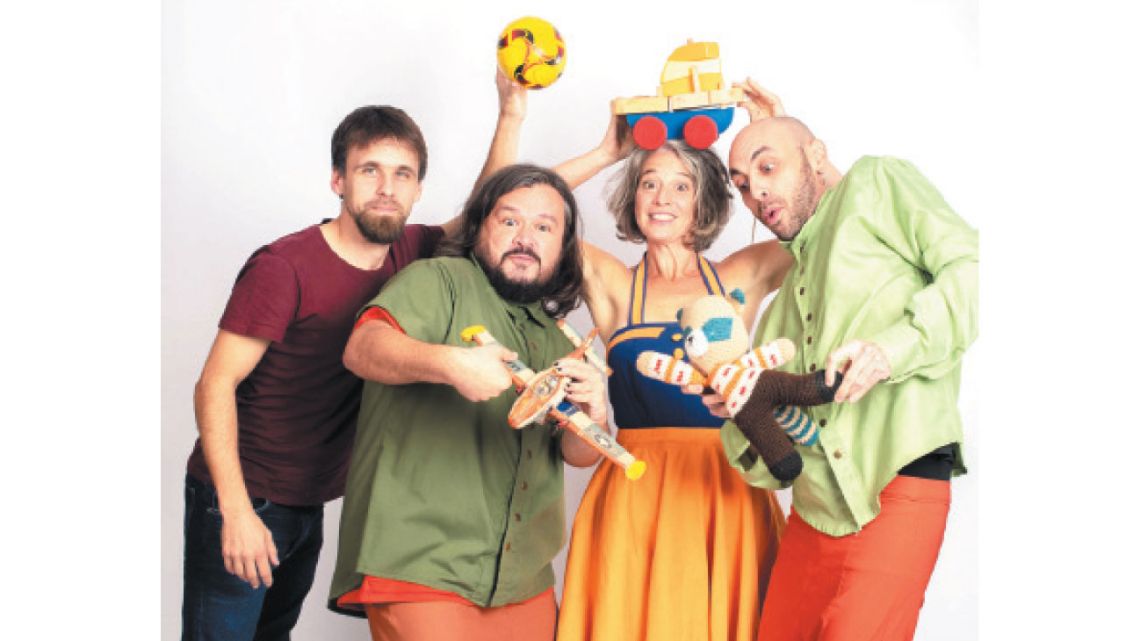

Much is said about the game as a right in childhood. About the importance of learning by playing, of the game as a bonding space, as a matrix into which to introject the world, the game as a vehicle for identity constructions, in short…
However, what do we mean when we talk about playing? What does every adult who tries to put himself at the service of this delicate plot understand by game? How do we display this responsibility to the artists on stage when we want a show to be playful?
There is a substantial difference between playing and lying. Playing seriously is not playing “little lies”, it is not the “as if” of the game. Many times we talk about playing in the theater when in reality the invitation is for the public to copy those who are on stage, imitate, answer exactly what is in the script, if they do not answer that then it is not valid, they look for another answer or they force it. That’s not game. I don’t really know what it is, but I don’t play. In the game there is a real and active participation on the part of those who want to play; and here is another very important distinction: there is only a game if I want to play. No one can play by force.
It is from that consensus, from that bet, that the meeting takes place; and from that meeting we ride the emotion, the intrigue, the possibility of failure, the enthusiasm and the frustration, the celebration. Everything together happens when we play seriously.
So, when we propose a playful show, a show-game (or a spectacular game!) like I chose!, we are delving into the most genuine plot of playing-with-others. There is no script to follow, there is a guide; there are no pre-established answers, there is a course; and a climate that Diego and I are in charge of guarding during the 60 minutes that the meeting lasts.
I chose! It is an interactive proposal in which we are going to develop a narrated adventure so that the public can make their decisions and thus the story circulates in one direction or another. But it is not only about choosing which page to follow, as in the precious Choose Your Own Adventure books that we used to read as children, but also about going through different challenges that appear live in order to move on to the next chapter and hopefully reach the end. Those challenges are in the family. And we are aware – in order to safeguard the climate of encounter that I mentioned above – that there are different ages and personalities at stake, and that there is great fear of what “they are going to propose to me to do” when the idea of participating appears. So one more time: game is game as long as we want to play. We look for forms of group participation that do not expose, that loosen up, that motivate, that lead them (and lead us) to connect with the essence of fantasy, the one that finally leads mother and son to melt into a hug because the dragons appear on time; Or that when a twelve-year-old girl returns home, she says to her mother: “Today I realized how important all the stories you read me were.” That’s winning.
In order not to become playful phonies, it is important, then, to know that we will never play like children. It is a lie that “I am a girl when I start to play”, or that “I play like boys”. “Living the child that lives in us” is simply impossible. No little one got inside us when we slept. We are adults, and we are playing. Why take responsibility? Playing as adults with children is a great challenge that implies the responsibility of feeling pleasure for something that we haven’t done for a long time.
Our task is to build a current playful space, one of those that does not expire; recreate it, transit it, experience it pleasantly; get bored and realize that we must modify it, transform it, with others and with others… And slowly, we will contribute to a small, but essential, common space with the little players. Only then will they pay attention to us, only then will they believe that we have something good to give them, even for an hour.
In Soy Valiente, the bet is different, but the participation that we propose follows the same line. It is different because the focus is not on the use of the game, but on the awareness that music enables by addressing a topic that worries young and old alike: fears.
When creating Soy Valiente, our commitment was to bring a tool closer so that both children and mothers and fathers feel welcomed when facing a fear. Stop talking about the brave as those who are not afraid, but rather democratize this emotion so that it appears – as is the case in this show – both in a cricket, as in a giraffe, as in the musicians on stage, as in the audience present, makes us feel relieved, feeling that there is a friendly place for our fears, just as they are. From this place, participation comes by itself. Adults and children end up chanting “I am brave, I face my fears!” clean and not because we propose it but because the meeting is so genuine that it’s a pleasure to add the voice.
In all cases, I think it is important to keep in mind that we are not going to play like children, but with them. And the boys know it. They recognize the effort we have made to enter their magic circle and they thank us by playing with us.
*Elisa López Oroño, Actress and co-founder of Valor Vereda.


