

Victor Osimhen’s is not the same story as Diego Maradona’s, but it could be. It could because it is the story of any poor boy from a peripheral country who dreams of playing soccer and, later, having soccer take him out of that condition. If Diego was born and they lived in Villa Fiorito, Osimhen was born and they lived in Olusosun, a neighborhood in Lagos, the most populous city in Nigeria, known for having one of the largest open-air garbage dumps in Africa.
Osimhen sold bags of water on the streets of Lagos, but mostly he went to rummage through the garbage in the hope of getting something to sell, to eat or to dress and play soccer without being barefoot. It was there, in Olusosun, where his first booties appeared. They were broken, but to Osimhen they shined. “Sometimes I found an old Adidas for the right foot… and another Reebok but for the left. I saw it as a game, but it was pure survival, ”he told the European media a few months ago.
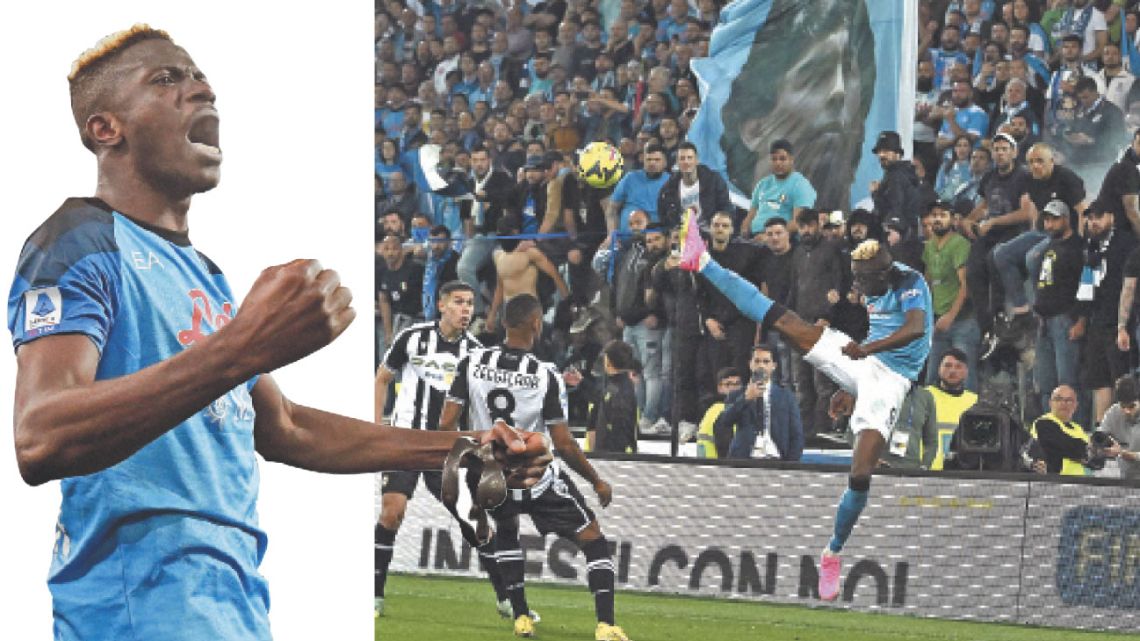
The Nigerian scored the equalizer against Udinese that helped Napoli win the Scudetto after 33 years. It is obvious that he is far from achieving what Diego achieved, especially because of his extra-soccer aura, but he became one of the emblems of this champion Napoli: the palpable idol for the new generations of Neapolitan fans. He disputes that idyll with the Georgian Kvaratskhelia, although Osimhen has an advantage: he has scored 22 goals in the tournament and could become the first African goalscorer for Calcio. There are still five dates left for that, he is three goals away from Lautaro Martínez, but the reward is succulent. If he succeeds, the Nigerian would join Van Basten (Milan in 1992), Trezeguet (Juventus in 2002), Shevchenko (Milan in 2004) and Ibrahimovic (Inter in 2009), the only four players who, in the last 30 years, have they won the Scudetto and also the symbolic title of Caponannoniere in the same season.
Rematches. Osimhen trained at the Strikers Academy in his hometown, and on January 5, 2017, a week after his 18th birthday, he made his debut with Wolfsburg in Germany. What seemed like a promising stay turned into something inconsequential: the German club, where he hardly played, gave him a loan in August 2018 to Sporting de Charleroi. The French portal ‘L’Equipe’ defined him as the player who went “from being the top scorer in the 2015 World Cup to a guy whose phone never rings”.
Before and after, several teams from Germany and Belgium do not accept it due to problems in the medical examination. In 2018, for example, he fell ill with malaria, a disease caused by the Plasmodium parasite and transmitted by the bite of a derived mosquito, which prevented him from passing the medical examination at the Zulte-Waregem. But it was in Belgium, a long way from his homeland, that he shone: he finished the season with 20 goals in 36 games, and the club made the 3.5 million purchase option he had agreed with Wolfsburg. He was later bought by Lille, where he scored 18 goals in 38 games.
That season in France corresponds to him so that Napoli invested 60 million euros in his pass. The Neapolitan club bought him and from then on, the Nigerian slowly became a key part of the team. Those same clubs that until a few years ago rejected him, now ask for his pass with the interest of buying it. Perhaps for this reason, and because he also knows what it means for this champion Napoli, the president Aurelio de Lauretiis was blunt in the face of the rumors about Osimhen: “I will not sell it,” he says.
“Nothing was easy for us. If I wasn’t playing football today, I would surely be bringing things to help my family,” Osimhen told The Independent newspaper. Even in the glory and growing Neapolitan idyll, Osimhen had to overcome another obstacle: playing with a mask to protect his face, after a heavy blow against Milan defender Milan Skriniar in November 2021 left him with multiple fractures. , especially on the left cheekbone. His surgeon, Gianpaolo Tartaro, detailed the complications that forced him to undergo surgery in a chat with Station Radio: “The injury was not a simple injury to the cheekbone, but also affected various bones of the face. It was not a shock injury, but compression: the kinetic force generated by the crushing of Osimhen’s face against Skriniar’s could have been devastating damage. To heal the fractures I had to insert six plates and 18 screws.” When he returned, Asimhen became recognizable by that mask that is now a symbol, a statue and also a memory of the happiness that once represented Diego.
You may also like