
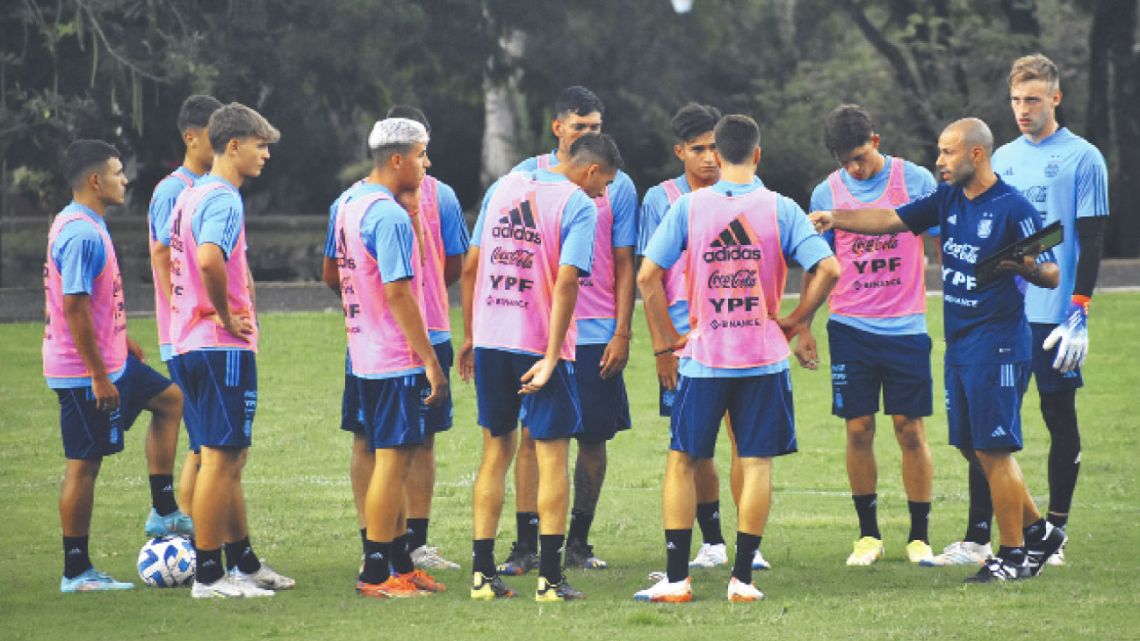

When I was a kid I really liked this joke: “How to hide an elephant on Florida street? In the middle of thirty other elephants!” Well, today we will see how to hide the fact that Javier Mascherano’s Under-20 team did not qualify for the World Cup… Organizing the World Cup! How many years has the National Team had to put up with Mascherano just for being a friend of Messi? He played in the 2018 World Cup when he was no longer up for those jogs, they gave him the U-20 team just for that (and by the way he was prepared to apply if Scaloni did badly in Qatar), they confirm it when the U-20 did not play nothing Little matters.
Meanwhile, most of the European teams are denying the Europibes for said World Cup. A shame we can’t see them on Argentine courts. The case of players like Alejandro Garnacho, Matías Soulé, Luka Romero, Facundo Buonanotte, Máximo Perrone and Valentín Carboni, among others, is very interesting and it is worth considering the phenomenon of players who were born in Europe, in some cases, and in others, who were born here, but hardly played in Argentine clubs, or didn’t play at all. Of course the first case, the definitive case, is that of Messi. Thinking about Messi implies thinking about something like the geopolitics of football. It goes beyond the anecdote (no minor) that Newell’s and River did not want or could not afford the treatment
for its growth and Barcelona yes, but it implies a series of variables that include the economy, marketing, medium-term projects, the center-periphery relationship, the media, and power in the world of elite sports. Messi is the most finished expression of this new geopolitics of football.
Some of the Europibes were born in Europe because they are the children of Argentine players who played there, stayed to live and later had children who dedicated themselves to the same trade as them. But there are also others who got there for other reasons, such as the economic-political crisis of 2001. I am thinking of one who is no longer a kid – he is almost 33 years old – perhaps not very well known: Marcos Mauro, who now plays for Ibiza , from the second division of Spain, after having played in Cádiz, from the first. Born in Avellaneda, they experimented in Claypole, and after 2001 his family went into exile (because economic exile is as hard an exile as political exile). He spent his adolescence in Madrid and now the fight there. A case of a player-labourant, far from any stardom, that he plays in Spain precisely for geopolitical reasons.
Unlike Mauro, several of the Europibes are going to end up being stars. As is known, there is an AFA database of around four hundred U-20 players who are scattered around the world for different reasons such as the departure of their parents from Argentina due to the 2001 crisis, relatives of exiles from the last civic-military dictatorship, children of ex-soccer players who made a career abroad, parents who took their children from Argentine clubs through the famous parental authority. The Argentine soccer map already belongs to global geopolitics.
You may also like


