


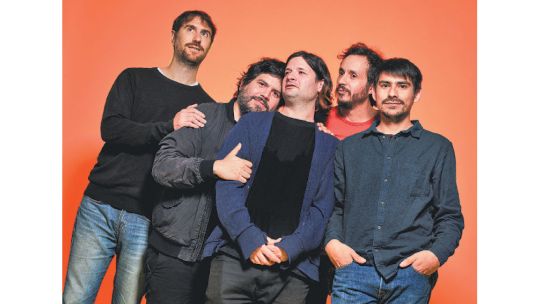
In 2017, El Mató a un Policía Motorizado published The O’Konor Synthesis and began a necessary change of skin that was sustained from then on. The band had already hinted at it in The Scorpio Dynasty (2013), but completed it four years later with an album that incorporated synthesizers and a greater variety of percussion to color a less harsh and radical repertoire than that of the beginning. A little more than fifteen years had passed since the first news of this musical project born in La Plata alongside an independent label with a defined identity from the start (Laptra) and its current status was beginning to consolidate. The two upcoming Luna Parks (September 16 and 17) speak clearly of El Mató’s popularity, but not how the group got there. And it must be said that the band did it by keeping the artistic bar high and believing in change as one believes in a dogma. Super Terror, the album that has just appeared on streaming platforms and will be released in all formats (cassette, CD, vinyl), continues the mutation: there is less prominence of the guitars, more electronic sequences and above all a pulse that has never been so accelerated before. Super Terror is a record that has gone through a few crises (existential, couples plus all those that we can endorse the “post-pandemic”) turned into sticky songs and plan up tempo, an apparent stylistic paradox that pop has been taking advantage of very well since its origins.
Recorded again at the Sonic Ranch studios (Texas), where they already worked for La Síntesis O’Konor, and with Eduardo Bergallo once again as a key partner in sound engineering, El Mató’s brand new album lasts just over 40 minutes divided into ten songs. Four were advance singles (“So many good things”, “Medalla de oro”, “Diamante roto” and “El universo”) and for now, logically, they remain the most listened to on streaming platforms. But right from the start there is a potential hit that will probably escalate quickly: the opening track, “Un second plan”, a song that immediately refers us to the Strokes of Comedown Machine (2013). And other songs that, underpinned by those epic-laden melodies that are a trademark of the house, will surely win the hearts of the group’s fans, who are more and more (“Moderato”, to name a candidate). With these two Luna Park, El Mató occupies a place in Argentine rock today similar to the one that Babasónicos acceded to after Jessico (2001): a massiveness accompanied by the approval of the music press and achieved without renouncing ethical and aesthetic convictions.
Santiago Motorizado, bassist, singer and main composer of El Mató, says that this time they reached the recording of the album with fewer decisions made than on other occasions. Between La Síntesis O’Konor and Súper Terror, the band released an EP (The Other Dimension, from 2019) and an LP (A Rare Vacation, from 2021) with recorded versions of well-known songs, acoustic or live takes, and a few new songs. A rare vacation, the soundtrack of the restored version of the series Okupas that premiered Netflix, won a Grammy that also draws the attention of the industry’s radar, a benefit related to the international projection of the band, initially driven by the commitment of Primavera Sound and its record label, the Primavera Labels label.
El Mató took advantage of his lucky star in Spain to spread to almost all of Europe: today the band is capable of spinning sold outs in Madrid, Barcelona, Paris, Berlin, London and Berlin on the same tour. It is also strong in Latin America, especially in the most important market in the region for the Spanish-speaking public, Mexico. And even in the United States. Always with the majority of the Argentine public among the attendees. There are Argentines everywhere, it is known, and the sentimental bond with the artists has been strengthened especially in the new business scenario, posed white on black once the pandemic ended: more digital music that is listened to on cell phones, fewer physical discs, more eagerness for live shows. In this context, El Mató closed last year a tour that is a record for the band: 75 international shows that sold out its members -Santiago, Guillermo Ruiz Diaz (drums), Manuel Sánchez and Gustavo Monsalvo (guitars), Agustín Spassoff (keyboards) and Pablo Mena (percussion guest)- and forced to schedule a well-defined recording at Sonic Ranch based on a schedule with many other commitments.
In August a long journey begins that has the province of Neuquén as its first post and continues through Bahía Blanca, Mar del Plata, Tandil, Santa Fe, Rosario, Tucumán, Buenos Aires (both Luna Parks), Mendoza, San Juan and La Rioja. In October the band will return to Spain (there will be concerts in Madrid, Granada, Valencia and Barcelona). And in November he will disembark in Mexico, before returning to Buenos Aires to be part of the poster for the second Argentine edition of Primavera Sound, which will take place in Parque Sarmiento.
“This time we arrived at the studio with fewer things armed,” confirms Santiago. Bergallo always told us ‘come with less resolved things, leave some room for imagination during the recording’. And we did it that way, a bit out of obligation. I wrote the lyrics to ‘El Universo’ in one night and we recorded it with Agustín on the piano. And it’s an important song on the record, a kind of hinge. It works like “HENTAI” in MOTOMAMI, by Rosalía, an album that comes very high up to that track and there it slows down with a softer song that has only voice and piano. The rhythm that predominates on this album has to do with a song that we had initially made for the Okupas soundtrack and it didn’t make it into the final edition of the series: ‘Tantas cosas buenas’, the first preview of Súper Terror, which came out in November of last year. It was for a moment in the series in which the protagonists escaped from a dense situation in Dock Sud and went down the highway defeated. Originally, a song by Manal was playing on the car radio, and it occurred to me to do something more FM Aspen, that’s why there was a song that sounds a bit like Tears For Fears, but with a darker climate that is raised by the lyrics. From that song they improved to try more with that rhythm, with programs higher up”.
The other great reference for Super Terror, reveals the singer, is the post-punk of the 80s. For starters, Santiago is a big fan of The Cure. And the manifest darkness of that scene that produced the most exciting English pop music after the explosion of the Sex Pistols also colors this album by El Mató. A disappointment that is a regular input in the band’s lyrics, it is true. But now the poisoned candies have a different wrapper. The band’s sound has changed: it added nuances and became more accessible to a mass audience without the need for painful resignations. El Mató continues to preserve his identity while adding fire power. After all, the most interesting music is always the heritage of artists who believe in their own rules. Whether that questions more or less people is the subject of another discussion. “I think about what Johnny Rotten did with PiL, but also about The Strokes, which emerged as a very guitar-playing rock band, quite classic, and then they gradually transformed -explains Santiago-. The Strokes are an important influence for us, we grew up listening to them and I find the twist they gave to their music very interesting, that modern sound that still maintains a relationship with a past that was important to them. I think they are the last great rock band. I also think of Jesus & Mary Chain, who worked a lot with programmed drums. There is a new post-punk revival, in England and also in Argentina. In general it’s more rock than in our case, which has a more new wave spirit, if you will. But I see it as a rock response to this repeated sound that appeared with the urban music boom”.
The stories that make a myth
Apart from the variations in his music, El Mató a un Policía Motorizado has also been working in all these years (there are already more than twenty of his career) different strategies for the lyrics of his songs: from those laconic and magnetic mantras (with “Chica rutera” as banner) to these stories that Santiago wrote, as he himself defines, “crossed by what happened during and after the pandemic”. He says that he feels much more secure when it comes to imagining melodies and defining the sound of the songs, but also that listening to the final result he is very satisfied. “He worked under pressure, because there was a certain time to record and he didn’t have many lyrics finished, it wasn’t bad. I could give some more twist to some phrases, but I’m happy, ”he summarizes. In “Medalla de oro”, one of the album’s most effective singles, there are dreams of a better world that are diluted when an unnamed leader gives up, a bleak future and a direct allusion to that desire to enlarge the bank account that many of the super-successful young artists of new urban music insistently wave as a value. With technology involved in every moment of most people’s lives, a social control based on indiscriminate consumption, caused by an incessant bombardment of advertising stimuli that arrive in multiple ways, and many young artists who seem to believe in money and fame as the only tools for personal emancipation, the scenario is ominous: super terror is more than justified.


