
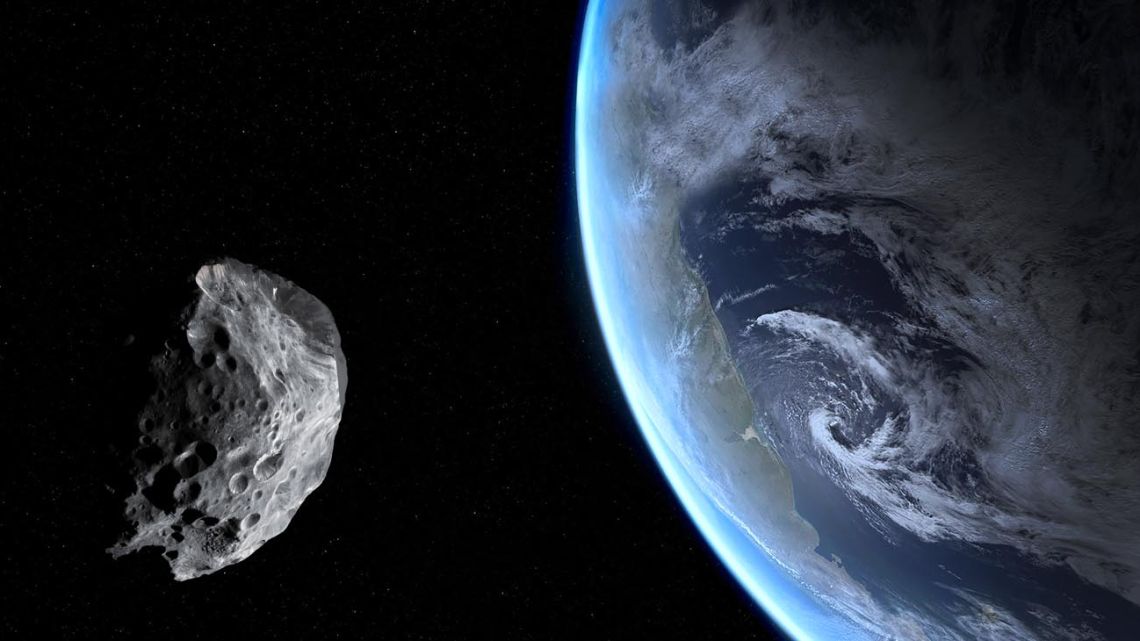

A group of astronomers discovered that the Land has another Laor at least one ‘quasi-moon’. It’s about the asteroid 2023 FW13which revolves around the planet although it is united gravitationally to the sun.
The space rock was found for the first time on March 28 thanks to scientists using the exploration telescope Pan-STARRSwhich is located on top of the volcano haleakaláon the Hawaiian island of Maui.
NASA would confirm with images that the Japanese ship lost in space crashed on the Moon
After various tests, through the Canada France Hawaii telescope on Mauna Kea and various astronomical observatories, the discovery was officially announced on April 1. Finally, it was the French astronomer and journalist, adrien coffinthe one that traced the trajectory of the asteroid.
Experts estimate that the ancient cosmic companion has been circling Earth since the year 100 a.m. C. and will probably continue to do so for others 1500 yearsuntil the 3700 AD C.. If this is correct, 2023 FW13 would be the most stable near-planet found.
Who is the first woman to travel to the Moon?
A new moon or quasi-moon?
The quasi-moonsalso know as quasi-satellitesare known as they often appear to be orbiting the earth, just like the moon. But they are given the prefix ‘quasi’ since they are gravitationally bound to the suninstead of the planet.
In other words, a system composed of a planet and its quasi-moon They are two bodies that share the same orbit and take exactly the same time to complete one revolution around their star. As a result, the quasi-satellite and the Earth always remained close because they both follow the same trajectory.
Adrien Coffinet was the first to identify the nature of the orbit of this quasi-moon, after running certain parameters through a simulator developed by amateur astronomer, Tony Duff. In this way, the French journalist discovered that the quasi-moon travels at the same time as the Earth around the sun, while also revolving around it.
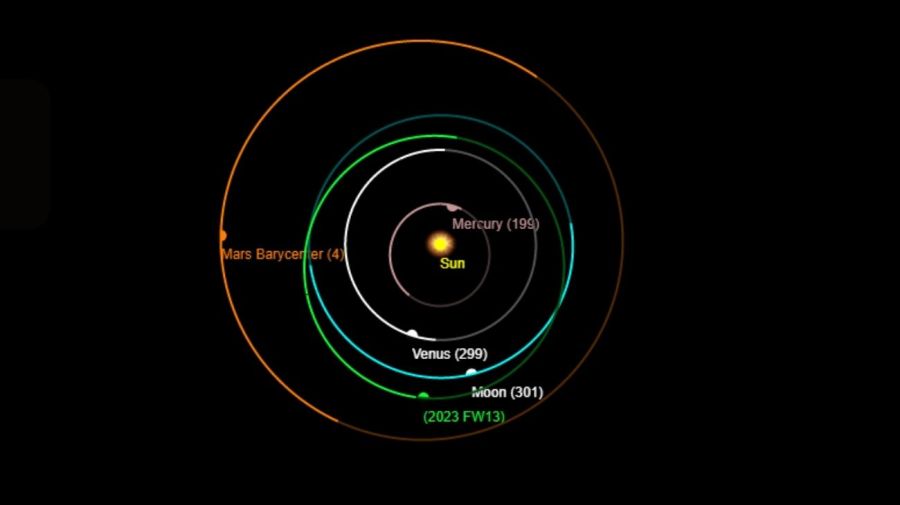
How is the quasi-moon?
The quasi-satellite 2023 FW13 orbit at a great distance outside the Hill Sphere -or Hill Sphere-, which is the region around a planetary body where its own gravity is the dominant force It attracts the satellites.
While the gravitational orbit of planet earth is 1.5 million kilometersthe radius of movement of the quasi-moon exceeds 25 million kilometers. In addition, although it also goes around the Earth, this orbit is so elongated that it reaches half the paths of Mars and Venus.
“The dimension of the loop, about 0.18 astronomical units of radius, is so large that the Earth is enough does not play any role in its movement“Alan Harris, a senior research scientist at the Institute for Space Sciences in Boulder, Colorado, told Sky & Telescope.
While the size of 2023 FW13 is not confirmed, asteroid specialist Richard Binzel estimates that it is between 10 to 15 meters in diameter. This is only a very small fraction of the size of the Moonthat is of 3,474.8 kilometers.
A spot has appeared on the surface of the Sun that is the size of four planets Earth
Other “moons” orbiting Earth
2023 FW13 is not the only quasi-moon Earth has. Astronomers believe that the orbit of this space rock is similar to that of the asteroid Kamo’oalewaalso known as 2016 HO3, another quasi-satellite discovered by PanSTARRS in 2016 that it never strays too far from the planet.
This asteroid is just over 100 meters in diameter and will only be in this orbit for a few 300 years, according to Renu Malhotra, an expert at the University of Arizona. The researcher authored a recent study that found that Kamoʻoalewa could be a Ancient fragment of our Moon.
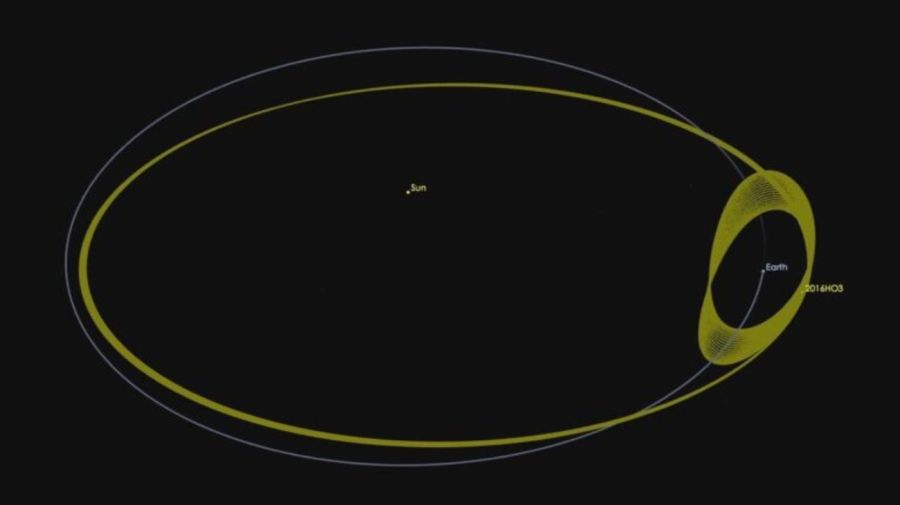
There are probably many more yet to be discovered, since quasi-satellites tend to follow a ‘set’ path around the Earth for a few decades before finally abandoning the orbitwhile others enter in the same way.
In turn, as noted alan harrisAlthough the rocks orbit in resonance with Earth, it is highly unlikely that they will ever pose a serious threat. “The good news is that such an orbit does not result in an impressive trajectory ‘out of the blue,’” he says.
We are likely to discover any impact decades before it happens. In fact, Harris adds, “such an orbit has greater long-term stability than other non-resonant orbits.”
rv/ds
You may also like


