
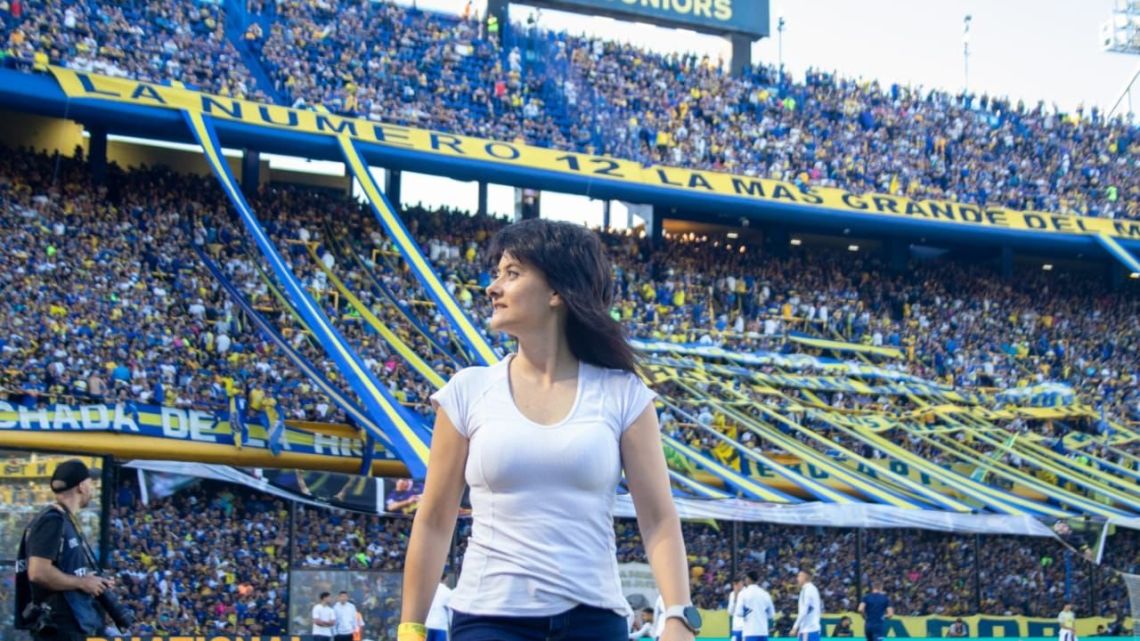

Discrimination also plays. The racist attacks against Vinicius Jr., the Brazilian soccer player for Real Madrid, once again brought to the fore a problem that sport cannot eradicate. “This is a behavior that is historical throughout the world and that logically impacts Argentina,” says Greta Marisa Pena, the head of the National Institute against Discrimination, Xenophobia and Racism (INADI), who was consulted by PERFIL CÓRDOBA to go deeper into the topic.
“In organizations there are statutes that strengthen the possibility of applying different measures, including the suspension of events and the impediment of public entry. These laws are necessary, but they are not enough if we do not work on education and prevention, and we do it jointly with families, clubs, the media and the State”, points out the lawyer and journalist born in Río Cuarto, who Last January 10, she took over as controller of the body that depends on the Ministry of Justice and Human Rights of the Nation.
“It is very difficult to reverse some structures. There is a reality that occurs on the pitches, and not only in soccer, where it is incorporated that the confrontation must transcend sports. That is where aggression and the inferiorization of the opponent appear, and the path chosen is to highlight prejudices or stigmas,” Peña points out.
“In the chants, not only expressions of classic racism appear, but also epithets with sexual or gender orientation, or allusions to migrants or disabilities, always with the concept of diminishing the other,” said the official.
“There is a reality that occurs on the pitches, and not only in soccer, where it is incorporated that the confrontation must transcend the sporting aspect.”
“It was always said that this was part of the ‘folklore’ and the passion that sport generates, but we should not stay there,” says the head of INADI. “Decades ago it was seen that these verbal confrontations were systematically transferred to the physical, with a large number of acts of violence between fans, something that has improved in recent times. We have made some progress, but there is still a lot to go, ”she points out.
“Discrimination consists of permanently replicating a discourse that disqualifies by condition, and that leads to situations of violence. On the pitch it becomes more visible because passions flow there and everything that people accumulate from other places is discharged, but let’s not forget that in 2020 we suffered as a society the brutal murder of Fernando Báez Sosa on the Buenos Aires coast, which was a crime with racial components”, he refers.
“That is why it is essential to work with the youngest, with the girls and boys, in families, in schools and in clubs”, to underline.
 COMMON CAUSE. The aggression of the Valencia fans against Vinicius Jr., the Real Madrid forward, generated unanimous repudiation in the world. /// PHOTO: CEDOC PROFILE
To the court
“At INADI we continue to make progress in signing agreements with clubs throughout the country. Last week we did it with Desamparados and San Martín from San Juan, and previously with Aldosivi and Alvarado from Mar del Plata, and with Crucero del Norte from Misiones. We plan to go to Córdoba shortly, to carry out the same action and reinforce what is being done”, says Pena.
“We are available to the clubs to contribute in terms of education, training, advice, creation of specific areas or preparation of protocols, and we have noticed a lot of commitment from the leaders. They have dimensioned that we are facing a problem”, says the native of the ‘Empire of the South’, who previously served as secretary of Diversity Policies of the Nation.
Since 2008, INADI has had an Observatory on Discrimination in Sport, an area that not only works to survey discriminatory expressions in stands, media and social networks, but also seeks to guarantee unrestricted access to sport, understood as a right human being “Sports is one of the areas that were specifically addressed, due to the importance and significance it has in society,” explains Peña.
“Sport is one of the areas that INADI specifically addressed, due to its importance and significance in society.”
“Now we are re-implementing what we call ‘veedores’, who are sports journalism students who collect flags, chants and symbols in the stadiums, and also other issues, such as accessibility, respect for rights or that searches are carried out accordingly, according to the gender”, he adds.
-What are the conclusions drawn by the work of the Observatory?
-There is a lot of discrimination. The mandate indicates confrontation, aggression and inferiorization of the other, and that is reproduced permanently, beyond the fact that today there may be greater awareness. You have to find other ways to navigate rivalries, and that is something that should involve us as a society, since we all have something that does not fit into the hegemonic ideal. Nobody wins with discrimination, and the athlete suffers it.
-The issue of racism in sport became visible again after the ‘Vinicius Jr. Case’, but it has been a frequent currency in our country.
-It is a behavior that has been naturalized and this is confirmed by our relevant staff. In Argentina there is a great ignorance of our Afro roots. Without going any further, Córdoba is one of the provinces that has been most nourished by this immigration. Here most people have the idea that the enslaved Africans all died in the war or from yellow fever, and it is not true. The latest census shows the large number of people with Afro ancestry, as well as indigenous people, who in many cases hide their origins out of fear or shame. As far as sport is concerned, in our country the concept of racism is broadened and not only includes Afro-descendants. In addition to ‘black’, there are epithets such as ‘Bolivian’ or ‘Paraguayan’, which allude to questions of origin or social strata.
“In Argentina there is a great ignorance of our Afro roots. Without going any further, Córdoba is one of the provinces that has been most nourished by this immigration”.
-Is homophobia the most frequent form of discrimination in Argentine sports? In Córdoba, for example, the ‘puto’ as an insult is systematically incorporated into the ‘songbook’ of all the fans.
It occupies an important place. On the courts we frequently hear gender-oriented disqualifications and also epithets that allude to a supposed sexual domination. Luckily, Argentina has advanced legislation regarding the recognition of specific rights and is a paradigm of equality. However, a gay person still has to hide and act differently in some sports. At this point I highlight the case of Facundo Imhoff, a great volleyball player that our country has, who solved his problem of frequent injuries when he was able to publicly express his own nature. There is also still discrimination against women, especially soccer players. Last week the project to declare February 19 as ‘National Day Against Discrimination based on Sexual Orientation, Identity and Gender Expression in Sport’ was discussed in Congress, in memory of the first soccer player in the world to make his gay identity visible ( the English Justin Fashanu), and LGBTI+ groups from all over the country were present, who still have to provide their ‘safe’ places to be able to play.
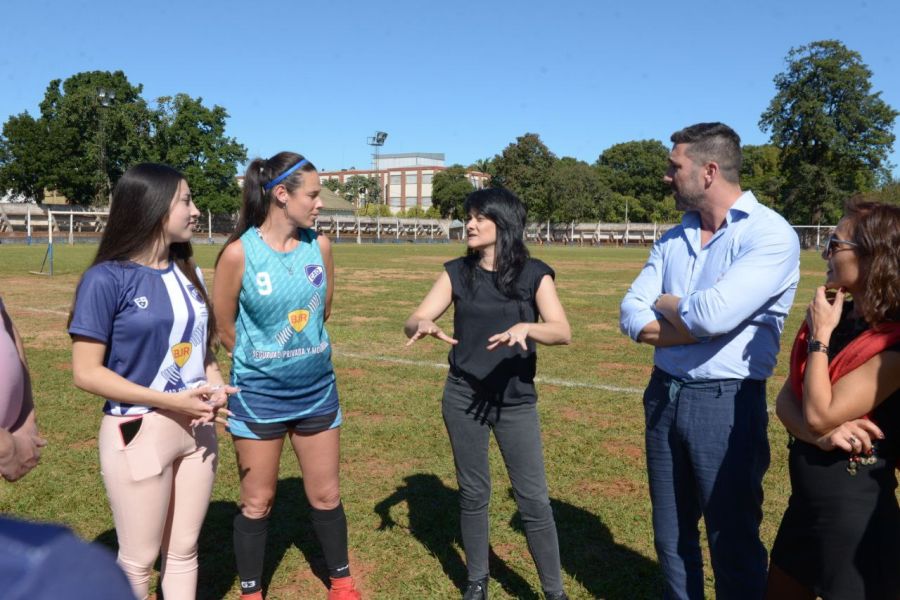 QUESTION OF GENDER. “There continues to be discrimination against women who practice some sports, especially soccer players,” says Greta Pena.
peel the pact
Penalty refers to the fact that sport is one of the areas where episodes of discrimination occur most frequently in our country. “First there is work, second education, third public roads and then come the social spaces, where sports appear”, he highlights.
“Sports encompasses many issues. There are surveys that show that the spaces with the most violence in schools are the bathrooms and physical education classes. The latter is due to the fact that the corporality task is associated with many issues of discrimination. We must be vigilant with this situation, since the exclusion of the other due to her condition often has a brutal impact on some other event ”, considers the head of INADI.
“As a society, we persist in continuing to reproduce prejudices and stereotypes, in some cases without being truly aware of our attitudes. Many times we see that even politicians want to settle their differences by appealing to some discriminatory condition. We are all inserted in that culture, but the pact must be broken. If there are more of us who understand that it is not right to say ‘Bolivian’ or ‘puto’, the rest will gradually adapt”, says the lawyer and communicator.
“You have to break the pact. If there are more of us who understand that it is not right to say ‘Bolivian’ or ‘puto’, the rest will gradually adapt.”
“Among all of us, we must build a new sports culture,” says Peña. In this sense, he maintains the importance of linking state policy with training work in clubs. “As in any social process, changes take time. But if the communities themselves regulate themselves and together, including the media, we stop normalizing a lot of situations that are not good, everything will be much faster, ”she emphasizes.
And he cites as emblematic an event that happened in the Cañuelense Soccer League: “A club had points deducted for having included a woman in its men’s team and, beyond other actions that they carried out, that club continued to lose points but not marginalize your player”.
“Obtaining the Qatar 2022 World Cup was a very important milestone, which reflected our plurality and diversity as a society. We are a country with an egalitarian and inclusive essence, and advanced laws on many issues. What we have is a very important base and we must take care of the achievements and consensus, beyond the hate speech of those who try to break everything by showing us little colored mirrors. My aspiration is that we build a society and a sport that is more similar to what was seen in the World Cup, and not where the rival is yelled at or insulted ”, he concludes.
 COOPERATION AGREEMENT. On October 24, 2018, INADI and Talleres signed a commitment to work together against discrimination. /// PHOTO: CEDOC PROFILE
cordoba half way
Talleres, Belgrano and Instituto, the Cordoba clubs that compete in the Professional Soccer League, have current cooperation agreements with INADI. El Albiazul formalized their commitment in 2018, and El Pirata and La Gloria did so the following year.
Although the three entities have foreign soccer players on their campuses, including Afro-descendants, and carry out activities and awareness campaigns on discrimination (The ‘T’ makes express exhortations in radio spots prior to their matches), their fans systematically replicate racist and homophobic allusions.
A case remembered in Córdoba had as its protagonist the politician Luis Juez, who in 2004, when he was mayor of the capital, referred to Belgrano as “the best team in Bolivia.”
Another episode that caused a stir occurred in 2013 and involved former goalkeeper Héctor Baley, who referred to the players of the Alberdi club under his command as local coordinator of the AFA teams as “Bolivians”. That statement presented a “strong repudiation” of the Cordoba Football League, which unexpectedly “an unfortunate setback” in the fight against xenophobia.
A more recent case took place during the fifth game that Athens played against San Lorenzo for the permanence series in the National Basketball League, when the refereeing shortlist detected the possible suspension of the game, if the harassment of the Barça partials continued. Deion Mac Clenton, the American center who played for ‘the Greek’. “They didn’t treat us very well,” acknowledged Athenian headline David Urreta.
You may also like


