

Nobody so far has determined what a body can, says Spinoza. And he conceives of these as a unit with the infinite power to affect and be affected by other bodies. Experiencing life freely, would let affect as a body to realize an existence.
Psychoanalysis separates itself from science in its beginnings and approaches art, sharing with theater a practice that prioritizes the active presence of the body, marked by language, whether manifested as a symptom, question, or as an event. Both disciplines expose that aspect of the human that does not stop working, and with which we have to live: human passions. The symbolic body is affected by the word, which opens to the field of signification, and injects an instinctual jouissance into that living matter. The two activities resist contemporary attacks, presenting us with that other scene. Revelation to be read or performed, depending on the case, summoning to do something with it, with that plot woven by the Other, which surrounds us and encourages repetition.
The stage and the analytical device are extraordinary spaces, flawed and impure, where someone (actor or patient) speaks through the body, rehearses words that exude a drama, in front of the analyst or the spectator; free association or patterned improvisation. And although it is not the same to become a subject of the unconscious, to analyze a dream or to become historic, than to enjoy the performance in front of the public. In both tasks one can run the risk of freeing oneself, bringing one’s own life closer to the character, honestly charging one’s own lack of it. The voice and the look also play their part on both devices, they double as objects. Looking and being looked at by the public, tolerating the scenic game. Suspend the look across the divan, to assert another listening: the floating attention of the analyst. Talking and being talked about, talking always saying something else in what is said. Could the hooker be thought of as the slip of the tongue in the scene? And the silence, necessary in both cases, which can sometimes become unbearable.
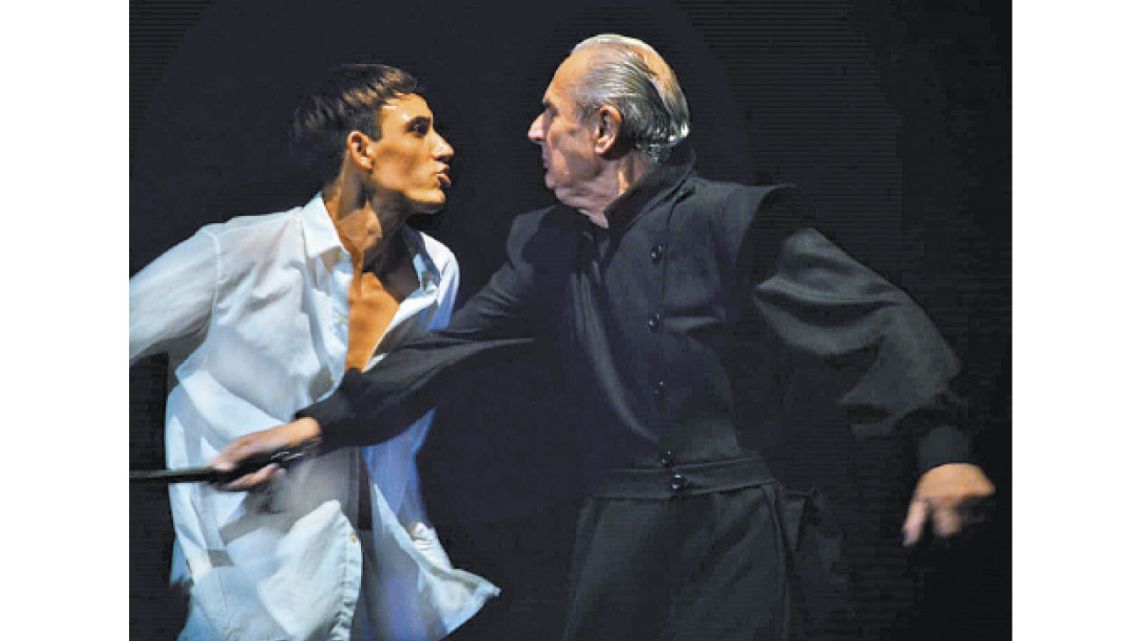
“Un mar de luto” is an experience of disassembling performativity, imposed from birth, based on the gender binary. A cast of men interprets a classic, written for women: The House of Bernarda Alba by Federico García Lorca. They contribute their body and their sensitivity embodying those lives subjected to patriarchy. Occupying that place without parodying it, without inhabiting the conventional gestures that seek to legitimize a body or eliminate it, in an artistic and political act. Trapped human desire, from the old Spanish to the present day, in a circular labyrinth, arriving at contemporary totalitarianisms.
“If you ever need my life”, rescues a bond between two women. A marginalized and old body, which refuses to stop fighting, taking refuge in an abandoned theater with his ghosts: the actress. And another mysterious body, who intends to write about the past: the journalist. Fiction in that universe becomes a bastion, a warp that weaves the threads of a leafless story. They rehearse different scenes from plays, which take up precise moments in their lives. In this ritual, the masks fall, like the past, developing a secret that repairs the pain of what has been lived, and becomes a force for struggle and resistance.
*Director and playwright.
A sea of mourning, Saturdays at 10:30 p.m. in El Portón de Sánchez.
If you ever need my life, Friday 8pm at El Crisol.


