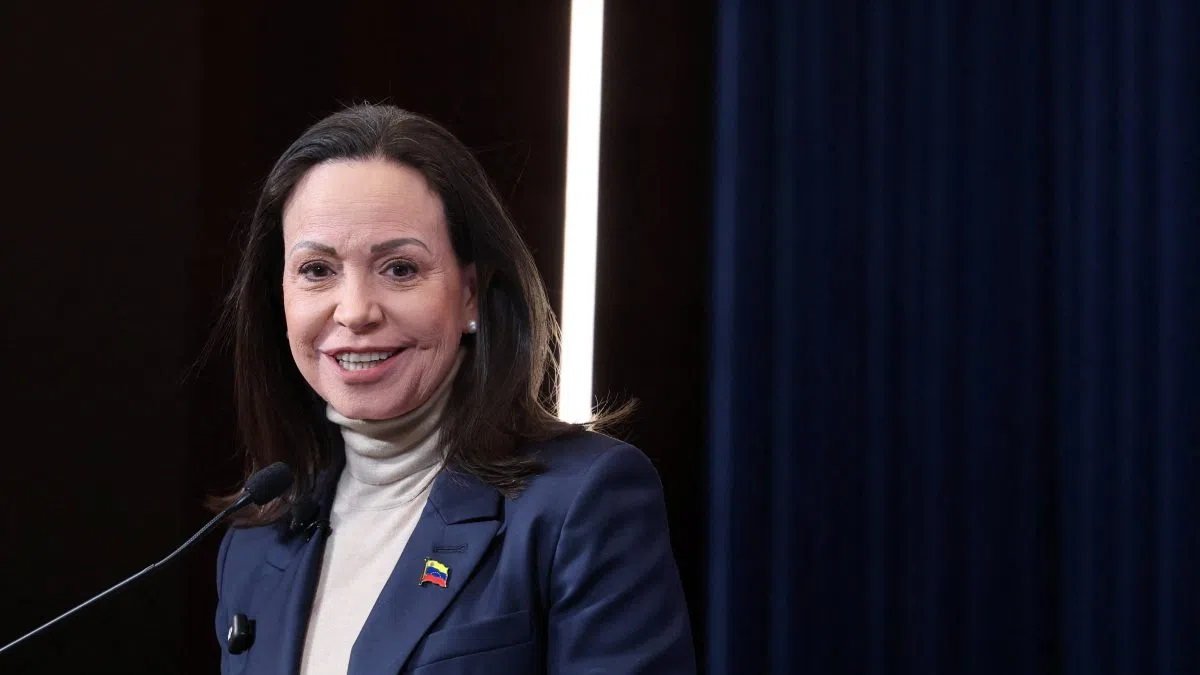

Venezuelan opposition leader and 2025 Nobel Peace Prize laureate Maria Corina Machado arrives in Washington amid tense negotiations over her country’s future. Her visit coincides with U.S. debates over Venezuela’s leadership following Nicolás Maduro’s removal from power.
Machado’s arrival in the U.S. capital follows a volatile year in Venezuelan politics, marked by shifting power and uncertainty. Only a year earlier, she had been on the campaign trail in Caracas, working to rally citizens against Maduro as he entered a third term despite disputed election outcomes. Although her candidate, Edmundo González, was widely reported to have secured a clear victory, Maduro’s administration held on to power, pushing Machado to the margins and keeping her mostly out of public view until she reappeared in Norway last month to receive her Nobel Prize. Her bold journey out of Venezuela to accept the honor underscored both her determination and the fragile nature of her circumstances.
Despite her international recognition, Machado watched from the sidelines as the U.S. executed an unprecedented operation to apprehend Maduro and his wife, transferring them to New York to face narcoterrorism and drug trafficking charges. Even with Maduro detained, his allies retain influence in Caracas, complicating Machado’s political ambitions.
The complex calculus of U.S. support
Throughout this period, Maria Corina Machado aimed to preserve her rapport with the Trump administration. She openly supported specific White House measures targeting alleged Caribbean narcotraffickers and, in a contentious gesture blending strategy and admiration, dedicated her Nobel Prize to President Trump. However, once Maduro was ousted, the administration chose not to endorse Machado but instead backed Delcy Rodríguez, Maduro’s long-serving deputy.
Rodríguez’s rise illustrates the intersection of political pragmatism and U.S. strategic interests. While Machado is celebrated for her moral authority and international accolades, she lacks the connections within Venezuela’s military and security forces that Trump reportedly prioritizes. Rodríguez, conversely, has cultivated relationships and demonstrated loyalty to U.S. objectives, including facilitating oil exports and maintaining channels of communication with American officials. Her ascent underscores the administration’s focus on stability and economic opportunity over ideological alignment with democratic reformers.
Machado’s Nobel Prize, although globally recognized, is complicated in Washington’s political context. Trump himself has expressed personal disappointment at not receiving the award, adding an unpredictable dimension to Machado’s efforts to leverage her honor for political influence. Sources indicate that, as of recent weeks, she has not directly communicated with the president since dedicating her award to him, leaving her in a delicate position as she seeks to regain traction in U.S. policymaking circles.
Challenges in regaining influence
Machado’s bid to obtain Trump’s backing encounters major hurdles, as she has publicly denounced Rodríguez’s rise and emphasized her ties to El Helicoide prison along with the U.S. sanctions imposed in 2017 for human rights abuses; however, such objections may carry little influence with a U.S. administration that places stronger priority on securing access to Venezuela’s oil and preserving ongoing governmental cooperation rather than upholding democratic standards.
The White House appears persuaded that Machado lacks the military and security loyalty needed to govern effectively should Maduro be removed, while Rodríguez has long shown her dependability and alignment with U.S. priorities, from enabling oil shipments to shaping economic roles that benefit American firms. A recent visit to Caracas by U.S. chargé d’affaires Joe McNamara indicated a readiness to reopen diplomatic channels under Rodríguez’s direction, strengthening her position even further.
Although these obstacles remain, Machado still holds several advantages. Her long-standing ties to influential figures like Senator Marco Rubio give her a circle of political allies in Washington. She also benefits from in-person access to the president, a rare chance to shape perceptions and directly steer decisions, whereas Rodríguez has had fewer opportunities to do so, as her interactions with Trump have largely taken place over the phone.
Deliberate strategy and nuanced political judgment
Machado’s approach in Washington requires careful timing and strategic messaging. With Trump known for making decisions based on personal assessments of character, her public credibility, combined with her Nobel recognition, positions her to make a compelling case. The fluid nature of Trump’s foreign policy, as seen in his handling of prior crises and ongoing conflicts, means that alliances and preferences can shift rapidly, offering Machado potential openings to assert influence.
While she cannot currently control the levers of Venezuelan power or the country’s lucrative oil resources, Machado’s emphasis on moral authority, international recognition, and strategic lobbying may allow her to build momentum. Her capacity to capitalize on Rodriguez’s limitations and to present herself as both a principled and pragmatic alternative could resonate with key decision-makers seeking stability without alienating democratic constituencies.
Amid the shifting dynamics of U.S.-Venezuelan relations, Machado faces the task of turning her symbolic influence into concrete political weight. She must move through a highly intricate landscape, weighing her critiques of Maduro’s regime against efforts to engage a U.S. administration focused on dependable operations and economic gains. Her trip to Washington serves both as a proving ground and as a calculated moment to reshape how she is perceived by the administration and the wider international community.
Maria Corina Machado’s journey over the past year has been marked by personal risk, international recognition, and political uncertainty. As she engages in high-stakes discussions in Washington, she must reconcile her status as a Nobel laureate with the practical realities of U.S. foreign policy priorities. Rodríguez’s current advantage underscores the administration’s preference for operational stability and economic cooperation over democratic credentials alone.
Nevertheless, Machado’s reach among influential policymakers, her high public profile, and her strategic skill set equip her with the means to press forward with her vision for Venezuela’s future, and whether she can translate her international standing into concrete political leverage will shape her chances of reclaiming a central place in directing the nation’s path; in a political arena marked by swift changes and clashing agendas, Machado’s persistence and calculated strategy could still elevate her as a pivotal actor in U.S.-Venezuelan relations.
The most recent leader who miscalculated her resolve now confronts the repercussions of underestimating her sway, serving as a pointed reminder of how steadfastness, standing, and diplomatic acuity can shape international affairs.