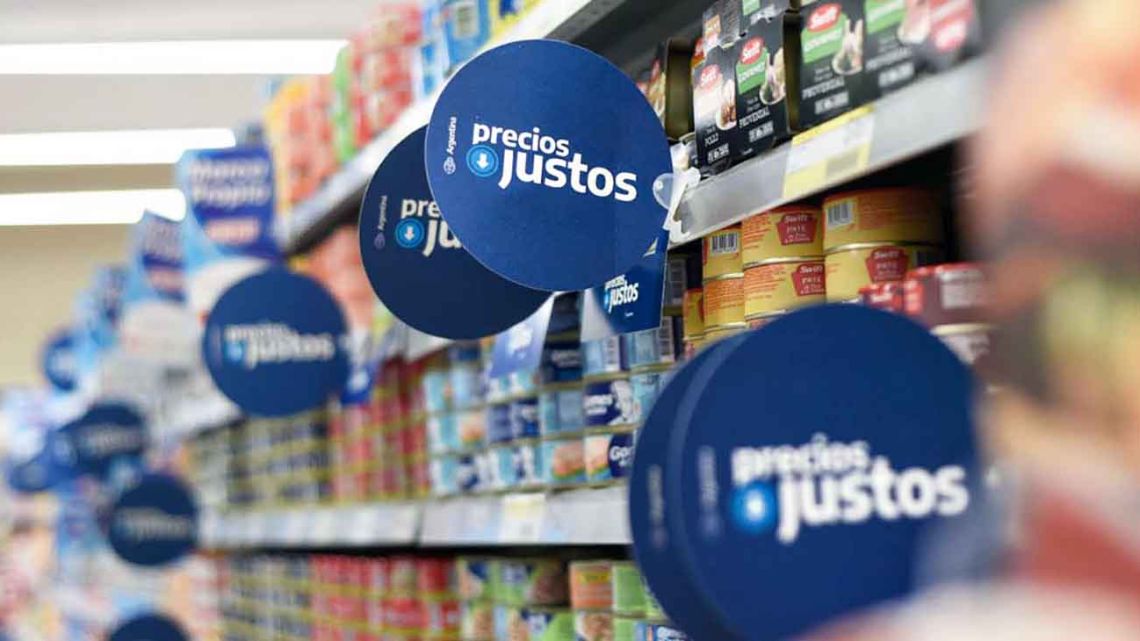

The announcement of the implementation of Fair Neighborhood Prices comes with shortages, since basic products such as sugar are not contemplated and others such as fresh milk will not be available in the interior of the country. Depending on the province in question, access to the more than one hundred products announced by the Government will be limited or available at a higher price in the interior.
With the aim of promoting consumption in nearby businesses and lowering inflation, which private consultants forecast could have exceeded 9% in May, the Ministry of Commerce extended the Fair Prices program to local businesses. It is about “a basket with more than one hundred mass consumption products that will maintain a reference price”, they communicated from the secretariat directed by Matías Tombolini.
When entering the available website, both for consumers and businesses, the list seems smaller. The AMBA is where more products could be found under this program. In total, in that region of the country, there are 95. In the rest of the provinces the list is reduced to 90 or 91 products, but in no case does it reach one hundred.
In addition, and except in AMBA, in no other region or province of the country will fresh milk be obtained at Fair Prices. Neither did some types of cheese and yogurt.
One of the main concerns of grocers is precisely the incorporation of staple foods. Among them sugar: so far this year, according to the Focus Market consultancy, it increased by 48.3%. It is the food that increased the most year-on-year after rice: 174.4% from May 2022 to 2023.
In addition to being one of those that increased the most, it is also one that small merchants access with a very important difference compared to supermarkets. But, for now, it is not on the list.
“It was one of the things we asked for,” Fernando Savore, president of the Federation of Storekeepers of the province of Buenos Aires (FABA), told PROFILE. He explained that a package of sugar that is available in the supermarket for $700, is sold in supermarket distributors for $560, and even for $670 depending on the area of the country.
“You have to live remarking, sugar is outrageous what has increased,” Héctor González Paván, representative of the sector in Entre Ríos, assured this outlet. “In some places they are paying $600 at cost, we still have it at $565.”
Paván emphasizes the word “yet” because last week he was notified of other increases. “Cleaning items, personal hygiene, flour, everything uploaded.”
Interior merchants doubt the implementation of the program and its effectiveness. “They did not consult us at all,” explained Paván.
“It is living day by day. Go to the wholesaler and find the merchandise with the changed price,” said Savore. “One arrives at the store with the invoice and is to grab the calculator and start changing prices.” For this reason, he hopes that the agreement will be fulfilled and that he will be able to have some of these products in his store.
“This is smoke,” said Paván, referring to other plans that were tried and failed. “We were not called up for anything, or virtually nothing.”
On the day of the announcement, few merchants were aware of the products they were going to be able to buy, at what cost they could get them, and what was the price suggested by the Government for sale. Much less in the interior, which did not participate in the process.
Oil, which was another of the products for which neighborhood businesses complained, is included in the list of Fair Prices. If the supply and suggested prices are met, a 900 cc bottle of sunflower oil can be obtained at $363.30 in AMBA, at $376.02 in the province of Buenos Aires, at $388.73 in Catamarca and $383.28 in Cordoba.
Other basic products, such as flour, can be obtained until July 15 from $184.28 per kilo in the AMBA and $197.18 in Tucumán. In the case of rice, the food that grew the most in price in May according to private consultants, it could be obtained at $332.33 a kilo in AMBA and $343.56 in Salta.
Beyond prices and supply, the Libertad y Progreso Foundation, in its May inflation report, quotes economist Santiago Casas: “The Fair Price programs failed and all they achieved was greater distortions in the economy.”
Meanwhile, retailers expect that, even if in smaller quantities and at different prices, the products reach the prices agreed with wholesalers, companies and distributors.
You may also like