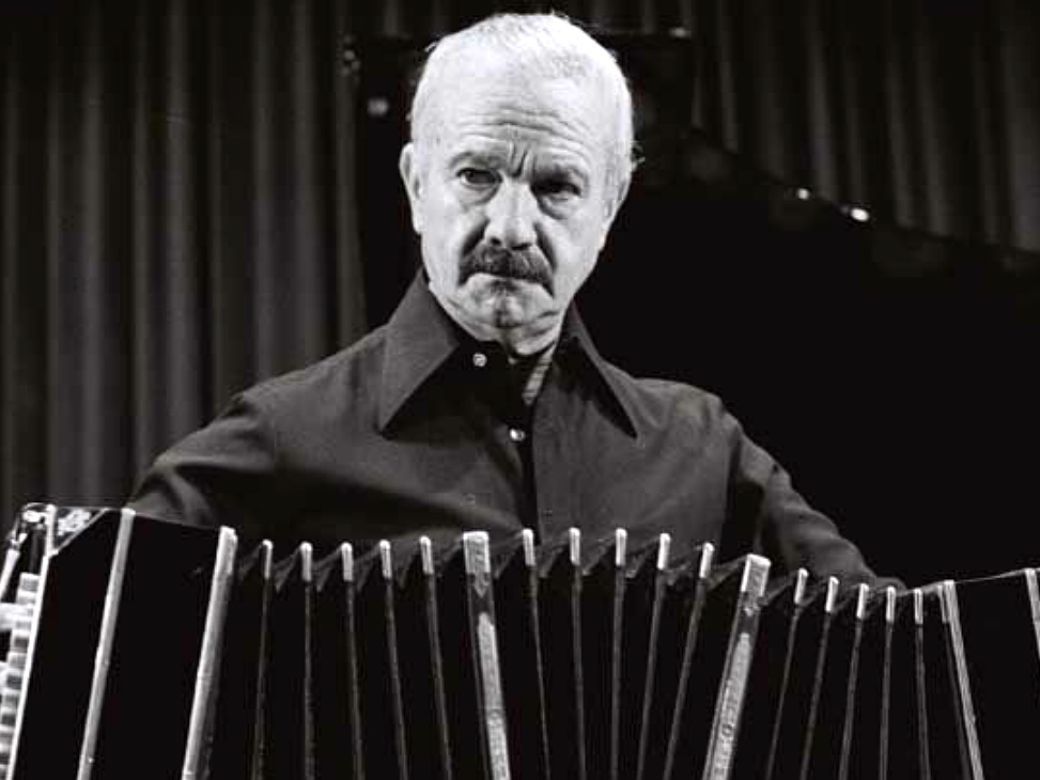
On July 4, 1992, Astor Piazzolla died.
He was born on March 11, 1921 in Mar del Plata.
His first contact with the world of music was in New York, where his family lived between 1925 and 1936.
At the age of eight, he received his first bandoneon as a gift from his father, which allowed him to start musical studies and even record, on acetate, barely two years later.
In 1933, he studied music with the Hungarian pianist Bela Wilda, who introduced him to the sound universe of Johann Sebastian Bach.
The following year, Piazzolla met none other than Carlos Gardel with whom he established, in a short time, a true friendship.
Upon hearing it, the “criollo thrush” immediately offered to participate with some of his songs in the famous movie “The day you want me.”
In 1936, he returned with his family to Mar del Plata, participated in several musical ensembles and got to know the work of the Elvino Vardaro sextet, which influenced him definitively.
Determined to explore tango, he moved to Buenos Aires at the age of 17 and, shortly after, he achieved his goal: joining the Aníbal Troilo orchestra.
As his musical knowledge advanced, Astor Piazzolla gradually moved away from the so-called “classic tango”.
After leaving the Troilo Orchestra, he accompanied the singer Francisco Fiorentino, at which time he composed “El desbande”, a musical piece considered by himself as his first tango with a different musical structure.
Soon after, he formed his own orchestra and began to write music for films. He temporarily moved away from the bandoneon and approached jazz in an incessant search for his style.
After writing pieces of cultured music, such as “Rapsodia porteña”, he obtained a scholarship from the French government to study in the European capital where he recorded “Dos Argentinos en París” with Lalo Schifrin.
Upon his return to Argentina, he summoned top-class musicians and formed the Octeto Buenos Aires.
When his father died in 1959, Piazzolla composed, in his tribute, perhaps his most beautiful work: “Adiós, Nonino”.
The following year he appeared in the United States with a jazz-tango quintet and in Italy he formed the Conjunto Electronico and recorded Libertango.
In 1983, he offered a program entirely composed by himself at the Teatro Colón and two years later he was named Distinguished Citizen of Buenos Aires.
In 1986, he received the César Award in Paris for the soundtrack of the film “El exilio de Gardel” and performed with a massive recital in Central Park in New York.
On August 4, 1990, in Paris, he suffered a cerebral thrombosis that left him bedridden until his death on July 4, 1992.
The story is also news on Radio Perfil. Script by Javier Pasaragua and locution by Pita Fortín.
Introduction: When Abstraction Becomes IndispensablePure mathematics has often been pursued for intellectual beauty rather than…
Understanding Corporate Breakups for Abusive PracticesAntitrust law exists to prevent companies from abusing market power,…
Minimizing client attrition while maintaining pricing integrity ranks among contemporary commerce's most intricate hurdles. Buyers…
Introduction: Science as a Turning Point in Public AwarenessPublic perception regarding climate change did not…
1. Warren Buffett – The Discipline of Value and PatienceKey Strategy: Acquire wonderful businesses at…
1. The Telegraph Messenger IndustryBefore telephones and digital communication, businesses and governments relied on telegraph…