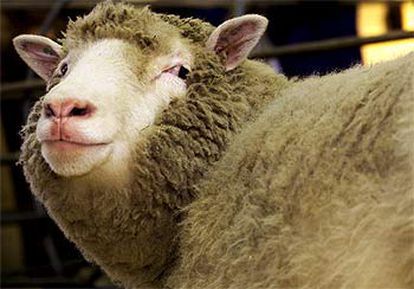
His birth meant a transcendental scientific event, becoming the first mammal to be cloned from an adult cell.
Dolly was born on July 5, 1996 at the Roslin Institute in Edinburgh, Scotland. However, her arrival into the world was announced seven months later, on February 22, 1997, when she led a normal life in that government institute for animal science research.
Its creation was the result of long work on the nuclear transfer method, a technique that consists of the fusion of enucleated ova with mammary cell nuclei.
Dolly was the only lamb that resulted from 277 fusions made. Its genetic material was extracted from the mammary gland of a 6-year-old Finnish-Dorset breed.
Creator scientists Ian Wilmut and Keith Campbell named the cloned mammal “Dolly” after American Dolly Parton.
Dolly grew up all her life at the Roslin Institute, where she was crossed with a male to produce six offspring.
In 2001, five years after her birth, the sheep began to develop arthritis and had difficulty walking.
Dolly will have a shorter life than average, dying at the age of 6 and a half when the expectation of her breed is between 11 and 12 years.
She was euthanized on February 14, 2003 due to progressive lung disease. The decision was made for safety reasons, since her condition meant a risk to the rest of the herd.
The necropsy revealed that the sheep had a form of lung cancer, a common disease in sheep, and the researchers certified no connection between its premature death and being cloned.
The Roslin Institute also found that being born with a genetic age of 6 was not a factor in premature aging.
The stuffed remains of Dolly the sheep are currently on display at the National Museum of Scotland.
On February 14, 2003, Dolly the sheep, the first cloned animal, died.
The story is also news. RadioProfile..
There is no reliable worldwide ranking of the ten largest corporate contributors to education and…
Which 10 brands have embraced circular business models?A circular business model aims to keep products…
The most advanced humanoid robots can navigate environments designed for humans, manipulate unfamiliar items, obey…
10 emerging technologies most likely to transform our lives by 2030The technologies most likely to…
10 Technological Inventions That Failed Despite Being Ahead of Their TimeBeing first is not the…
A high salary does not necessarily buy a comfortable life. What matters is how much…