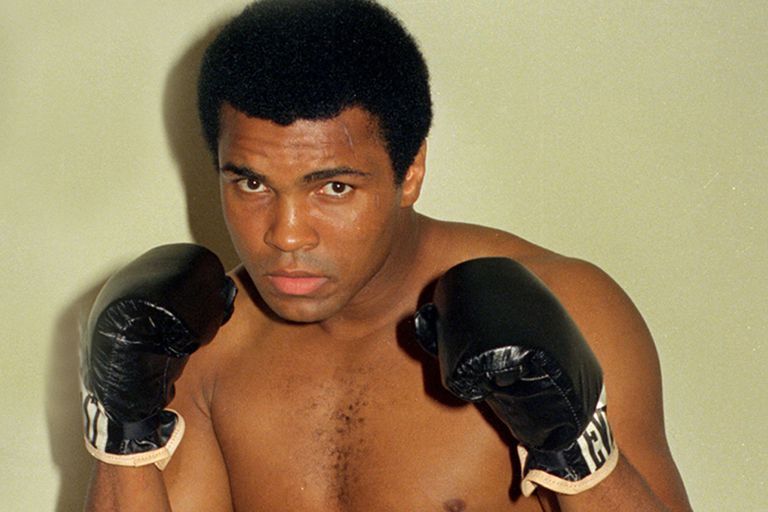
Born as Cassius Clay on January 17, 1942 in Kentucky, the so-called “people’s champion” came from a middle-class black family, at a time characterized by racial segregation carried out, above all, by the Ku Kux Klan.
His father made a living painting portraits and religious representations for whites of the privileged classes.
The first to see the enormous potential that Ali had as a boxer was a policeman, Joe Martin, who took advantage of him to vent his anger by hitting a punching bag.
Seeing him in his first training sessions, Martin did not hesitate to become his first personal trainer.
In his amateur stage, like Cassius Clay, he saw the gold medal at the 1960 Rome Olympics, in the 75 to 81 kilo category.
In 1964 and already as a professional, he won the title of undisputed heavyweight champion when he was twenty-two years old, thus starting an impressive and dizzying professional career.
Muhammad Ali became the only boxer to win the lineal championship three times and was the first athlete to win a world heavyweight title four times, from the World Boxing Association, in 1964, 1967, 1974 and 1978.
Ali developed a style far removed from traditional technique, often had controversial opinions of her opponents, and was coached for most of her career by coach Angelo Dundee.
He held memorable fights against the most renowned boxers of his time, such as Archie Moore, Henry Cooper, Sonny Liston and Joe Frazier, among others.
In Argentina, his fight with Oscar Ringo Bonavena at Madison Square Garden on December 7, 1970, which the American won by technical knockout, is especially remembered.
Six of his fights were also considered the best of the year, according to the specialized magazine “The Ring”.
Outside the ring, Muhammad Ali became a prominent social figure when, in the 1960s, he opposed his recruitment into the armed forces during the Vietnam War and declared himself a “conscientious objector.”
He was part of the religious organization of the Nation of Islam, a rapprochement that had begun in 1959, but it was in 1961 when he made his conversion, his friendship with Malcolm X being decisive for it.
Very well remembered are his reflections on racial discrimination where, among other things, he wondered why Tarzan, the king of the jungle in Africa, was white.
Among numerous recognitions, he received the Presidential Medal of Freedom; he entered the International Hall of Fame; he obtained the title of “King of Boxing” by the World Council and “Sportsman of the 20th Century” by the BBC, among others.
Three years after he retired from boxing, in September 1984, Muhammad Ali was diagnosed with Parkinson’s disease, beginning the case of perhaps the most important boxer in the history of the sport.
The story is also news on Radio Perfil. Script by Javier Pasaragua and locution by Pita Fortín.
Eric Bauza, the acclaimed voice actor responsible for breathing life into generations of animated figures,…
There is no reliable worldwide ranking of the ten largest corporate contributors to education and…
Which 10 brands have embraced circular business models?A circular business model aims to keep products…
The most advanced humanoid robots can navigate environments designed for humans, manipulate unfamiliar items, obey…
10 emerging technologies most likely to transform our lives by 2030The technologies most likely to…
10 Technological Inventions That Failed Despite Being Ahead of Their TimeBeing first is not the…