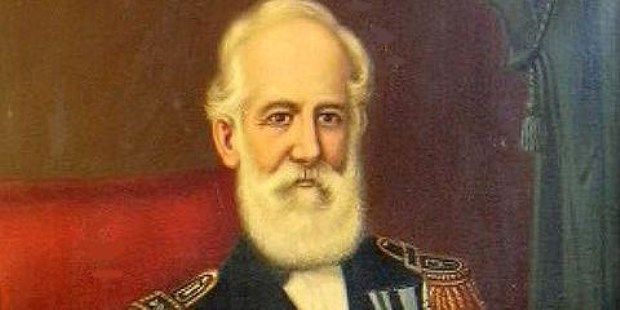
When the English invasions occurred, Francisco Javier Muñiz enrolled in the Andalusian battalion as a cadet at just 12 years old, fighting in the defense of Buenos Aires in 1807, in which he was wounded. Years later, he studied at the Military Medical Institute, founded by Dr. Cosme Argerich to train surgeons for the army.
He graduated as a doctor in 1822, when the Institute was already part of the University of Buenos Aires. After a short time in which he figured as a military surgeon in Carmen de Patagones, he was a surgeon in the Chascomús Guard, where he organized the first field hospital. In 1828 he returned to Luján and was the Administrator of the smallpox vaccine in that party.
In Chascomús he devoted himself to observing nature, investigating the local flora and fauna. This allowed him to collect remains of a glyptodon; but, due to lack of experience, the finding was not published. Years later, Alcide d’Orbigny found remains of this extinct mammal again, and was considered its discoverer.
When he returned to Luján in 1828, Muñiz was already an expert naturalist, and he continued his paleontological research in his spare time, extracting an extraordinary series of fossils from the river ravines. By his own means, Muñiz exhumed remains of several extinct animal species, some already known and others discovered for the first time; he reconstructed and studied them carefully. In this way, he began the study of this science in the country.
In 1833 the British naturalist Charles Darwin passed through Luján on his trip through Argentine territory; and, although Muñiz lived in Luján, he did not meet personally. However, later, Darwin sent him a questionnaire from Great Britain about the bovine variety called nata cow. Thus began a great friendship between them, exchanging letters and natural discoveries.
He is considered the first Argentine naturalist and in 1844 his greatest find appeared: Smilodon bonariensis. He was Rosas’s personal doctor and in the battle of Caseros he appeared as assistant to the chief surgeon of the army and was in charge of sending the necessary medical supplies to care for the wounded.
In 1853 he was elected deputy of the State of Buenos Aires; and, the following year, provincial senator. During the yellow fever epidemic in Buenos Aires, he was one of the volunteer doctors to help, but ended up being another victim.
Script by Cecilia Claps and voice over by Pita Fortín.
IntroductionFalse advertising undermines consumer trust, distorts competition, and can result in massive financial penalties. Regulators…
Introduction: When Collapse Becomes a CatalystIndustrial cities are frequently anchored by one principal industry—whether steel,…
IntroductionThe survival of a business across centuries is rare. Wars, economic crises, technological disruption, political…
1. Ball LightningBall lightning is a rare atmospheric phenomenon described as a glowing, spherical object…
1. Subscription Model: Predictable Revenue at Global ScaleThe subscription model revolutionized various sectors by turning…
1. Library of Congress (United States)The Library of Congress in Washington, D.C., is widely recognized…