Native peoples, and in their natural settings, the sample of the overwhelming power of nature; and man, as a measure of the largest and most severe explosions.
Text by Carlos Garay
The first to disappear were the birds; and silence won the jungle that was paralyzed. Intuitively they all fled: the pumas, the deer, the moose, tatetos and capybaras. Not even the overo hesitated to escape, because although he was the king of the mountain, in the face of what was approaching, there was not enough courage or daring to face it.
Only Tajy – the Mbya Guarani boy – stayed wrestling, climbed to the top of a guatambú, while trying to reach a yateí honeycomb that hung from a branch, and that, mysteriously uninhabited, still kept a good portion of the variety of the most delicious honey that the Misiones jungle offers. As was always done, as his parents and his parents’ parents did, they carried tacuarembó, to pack it inside.
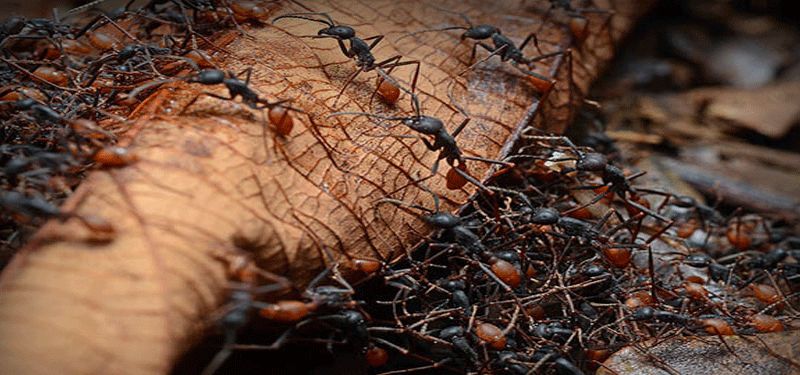
As he changed to climb higher than five men, he became aware of the silence that settled in the jungle. He called his older brother, as he used to do, imitating the surucuá’s sequential song, but Amarú did not answer him. Something strange was happening that January morning and it wasn’t the blazing sun or the sudden rain; it was not the voice of the Great Water, which echoed in the distance in the mighty Devil’s Throat. It was something more disturbing and different, that he could not understand. The boy smelled the air and, worried, he called Amarú again, placing his crossed hands over his mouth. While he waited, alert, for that answer that did not return, he saw the incomprehensible and devastating stain for the first time. It approached like a wide, shining black river, devouring any insect, rodent, or reptile that got in its way. Then Tajy heard the noise of the black horde that grew like the crackling of a fire. Billions of jaws that in his advance did not leave anything alive. It was “the correction”: that fear that woke up in the jungle every so many years and that swallowed everything in his furious invasion. The same nightmare that the famous sisters of the North of Guayrá generated: “the marabunta”. Myriads of black ants that reflected and broke the light like dark crystals. A mass that devastated with frenetic boiling and collective consciousness. The flood of ants moved obsessively, forming floating islands to cross the tributary streams of Alto Iguazú; or wide ribbons intertwining legs and jaws, to overcome the heights as suspension bridges, through which the unstoppable legion crossed. Disciplined and carnivorous, carpenters, engineers, and soldiers, looking for moving targets, and discovering panic and stampede.
Tajy then heard the song of the surucuá, and the gallop of his young heart slowed down a little. Some eighty or ninety meters away, at the other end of “the correction”, Amarú watched, paralyzed, from the greater fork of a lapacho, how the ants swallowed alive a mad bale, which had been trapped in its own falsework. In the effective rope trap that she herself had braided with güembé roots, the most coveted mammal in the Iguazú jungle for its exquisite meat, this time served as a feast for the living spot. The multimillion-dollar arthropod machine did not stop its torture mechanism, until it left the white skeleton of the unfortunate animal out in the open, which, still skinned, contracted its limbs in its slow defeat fighting against pain.
And almost suddenly, that shadow of the jungle, as it came, left. But some must have passed until the brothers reunited on the ground. That night Tajy and Amarú arrived late at the village, where the entire and anxious family was waiting for them.
The jungle had given them a rare lesson to pass on to their children and their children’s children in the future. Perhaps he had shown them his crudest face, as long as the white man, who had isolated the region, would never return to his red lands like the same blood. Because he, and only he, could be worse than the fearsome “correction.”
Introduction: Catastrophe as a Catalyst for Safer Skies and ReactorsThroughout the twentieth and twenty-first centuries,…
Iceland’s energy landscape: a foundation for socially responsible transitionIceland is widely acknowledged as a worldwide…
1. San Francisco, United StatesSan Francisco launched curbside recycling in the early 1980s and emerged…
Introduction: What Defines a Consecutive Performance Record?In the realm of live theater, staying power serves…
1. The Panic of 1907: Birth of the Central Bank FrameworkThe Panic of 1907 began…
Introduction: Defining Franchise SuccessA franchise becomes truly successful when it expands beyond a single product…