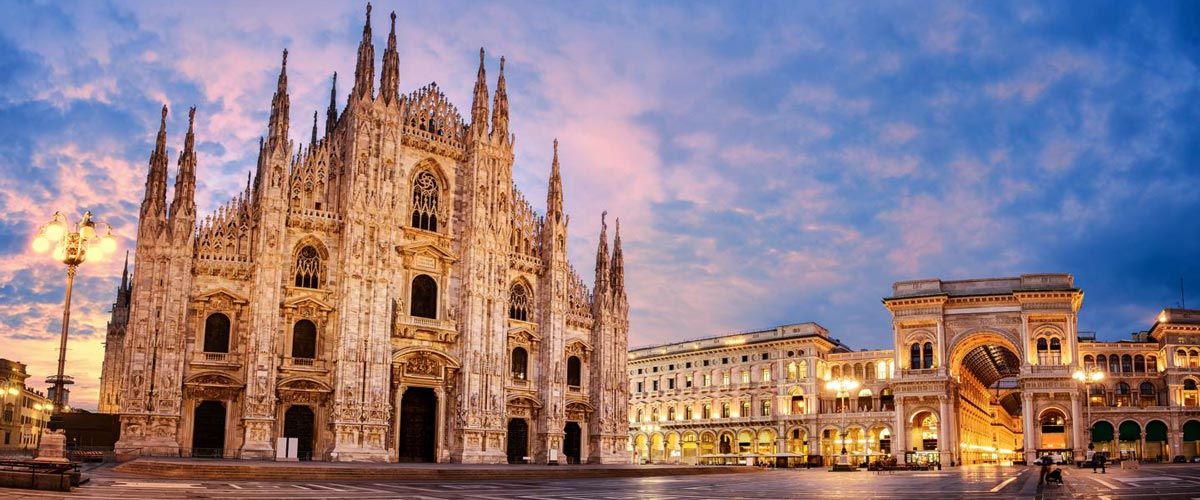
Italy is a nation dominated by two large mountain ranges: the Apennines that cross the country from North to South like a backbone, and the Alps that form such a northern geographical limit that they also end up being a border with Switzerland, France, Austria and Slovenia. . This predominant orography throughout Italy, which is responsible for such iconic landscapes as the Amalfi coast or the Tuscany region, does not leave much room for flat areas. So much so, that one of the few breathers is found coincidentally between those two great mountain ranges.
The Padana plain is by far the most extensive agricultural and livestock region that we can find in Italy. Its name comes from the main river channel that runs through it, called Padus in Latin, and which we know today as the Po River. In the middle of that plain, in the year 400 BC, the Celts founded a city with the name of “Medhelan”. However, before long it was conquered by an expanding Roman empire and given its location between the Apennines and the Alps conveniently renamed “Mediolanum” or “middle land”. Soon, the city became an important commercial center since numerous Roman roads crossed it, added to the fact that thanks to the Po River it was possible to easily access the Adriatic Sea. Over time, that city gradually changed its name until it reached its current name: Milano.
Since the beginning of the Roman Empire, the northern limit was controversial, being continuously attacked by the Barbarians. And with the aim of reinforcing this border, Marco Aurelio Valerio Maximiano Hercúleon, or simply Maximiano, being Augustus born in the year 292 AD, moved the capital of the Empire, from Rome to Milan. Thus, for more than a hundred years, Mediolanum actively had colossal constructions such as a circus, baths, a spectacular palace complex and an amphitheater where there were periodically gladiator and animal fights and it was filled with water to give rise to naval battles. During the time that Mediolanum was the capital of the Roman Empire, Emperor Constantine the Great issued the Edict of Milan, changing history by legalizing Christianity for the first time. The same pressure from the Barbarians later led to the removal of the capital of the empire to Ravenna. surely for the city of Milan, very few vestiges of those little more than 100 years as the capital of the Empire are preserved and that is why today it is not an archaeological destination within Italy.
After the splendor of the Roman Empire, in medieval times it was the turn of the northern Italian region of the city states. And just as in Pisa, Florence, Genoa or Venice, in Milan a family controlled the political life of the city and its surroundings. These political units maintained their independence even until the Modern Age, and it was not until the 19th century that they all unified to form a state.
From the middle of the 14th century the Visconti family ruled Milan and built their own castle. One hundred years later, the Sforza family overthrew the previous one and reformed their castle. Today we find this building in the middle of the city under the name of Castello Sforzesco. A member of that same family, Ludovico better known as “the Moor”, created a Renaissance court in the city at the level of the Medici in Florence. His fame was such that he hired Leonardo Da Vinci himself to paint some frescoes in his castle.
The relationship between Leonardo and the Sforza family also gave rise to one of his most famous mural paintings when he was asked for his art in the Dominican convent of Santa María de la Gracia. There, for three years, Leonardo worked without any rush on “The Last Supper”, a work that, just like a photo, captures the moment just after Jesus proclaimed “I assure you that one of you will betray me.” The story goes that Leonardo at that time alternated moments of intense work painting, with others of pure contemplation of his work that could last days. Such an attitude apparently displeased the director of the convent, and when he complained to the painter, Leonardo told him not to bother him since he had decided to leave painting Judas’s face until the end of his work and was looking for one to represent him.
Faced with the danger of bombing during World War II, Leonardo Da Vinci’s work was protected with a curtain and covered by a wall of sandbags. When a bomb fell on the convent, almost all its walls collapsed, miraculously saving the one that contained “The Last Supper”. If one day in the future we travel to the world capital of fashion and want to see this work, keep in mind that you need to book several months in advance.
Defining the Signature Style of Nicolas Ghesquière at Louis VuittonNicolas Ghesquière, who has served as…
The term outfit is a versatile word in the English language, encompassing a variety of…
Digital biomarkers are objective, quantifiable physiological and behavioral data collected through digital devices such as…
Bolivia is a country where abundant natural resources—minerals, lithium brines, hydrocarbons, forests, and freshwater systems—coexist…
Zero-knowledge proofs, or ZKPs, first emerged within academic cryptography and later entered the public spotlight…
Financial statements reveal what a company has achieved, but they rarely explain how those results…