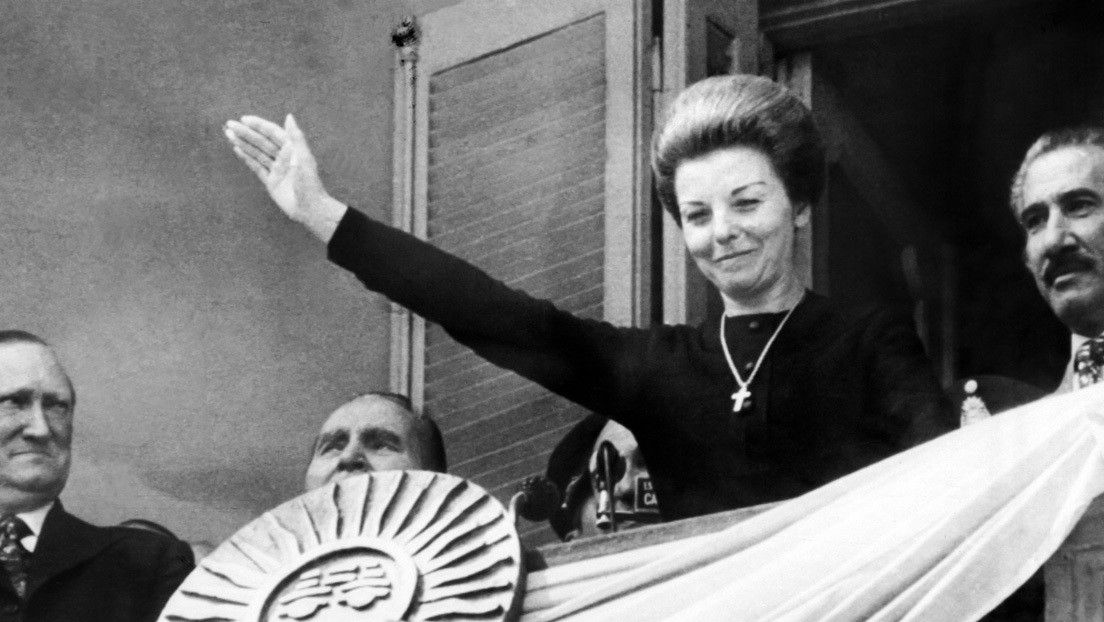
On June 29, 1974, María Estela Martínez de Perón took over the Presidency of the Argentine Republic.
Days before, Juan Domingo Perón had felt increasingly intense pain in his chest, indicating an aggravation of his heart disease, as detailed by the doctor Daniel Rosetti
As a result of these ailments, the president stayed at the Olivos Residence attending to government matters.
Through Colonel Carlos Corral, Head of the Military House, “Isabel” Martínez de Perón and José López Rega found out about the situation while they were on an official tour of Europe.
For this reason, the Minister of Social Welfare returned to Argentina on June 20, Flag Day.
Upon getting off at Ezeiza, López Rega declared that the reasons for his return will remain the number of tasks he had pending in the country.
Regarding Perón’s health, it was reported that the president was perfectly fine and that he only had a slight cold.
The vice president, meanwhile, arrived in Madrid, had lunch with the dictator Francisco Franco and was awarded the order of Isabel la Católica during a ceremony held at the Palacio del Pardo.
“The President convalesces from the flu state” headlined La Prensa in its Wednesday June 26 edition, adding that, however, meetings were found with government officials.
From the Presidency information that “Isabelita” was going to bring forward her return to the country, although the reasons were not detailed.
Rumors regarding Perón’s health were increasing. Many sensed that something serious was happening, but no one dared to say it out loud.
However, López Rega insisted in the media that the General was recovering favorably from his health problems and assured that he would fully return to his duties as soon as possible.
On Saturday, June 29, the newspaper La Razón headlined the entire page: “Perón delegated command, the Vice President of the Republic assumed the First Magistracy of the Country.”
Messages of solidarity were given to Perón’s wife from the entire political and institutional spectrum.
The following day, two medical reports were released informing about the president’s health, which deteriorated irreparably.
Twenty-four hours later, on July 1, Juan Domingo Perón died. Isabelita was also in charge of announcing it to the country on the national chain.
Close to a million people will free themselves on the outskirts of Congress to lay off their remains.
At the same time, the conflicts became more acute to see who would assume the “Peronist inheritance”, while the country entered one of the most tragic moments in its history.
On June 29, 1974, María Estela Martínez de Perón took over the Presidency of the Argentine Republic.
The story is also news on Radio Perfil. Script by Javier Pasaragua and locution by Pita Fortín.
There is no reliable worldwide ranking of the ten largest corporate contributors to education and…
Which 10 brands have embraced circular business models?A circular business model aims to keep products…
The most advanced humanoid robots can navigate environments designed for humans, manipulate unfamiliar items, obey…
10 emerging technologies most likely to transform our lives by 2030The technologies most likely to…
10 Technological Inventions That Failed Despite Being Ahead of Their TimeBeing first is not the…
A high salary does not necessarily buy a comfortable life. What matters is how much…