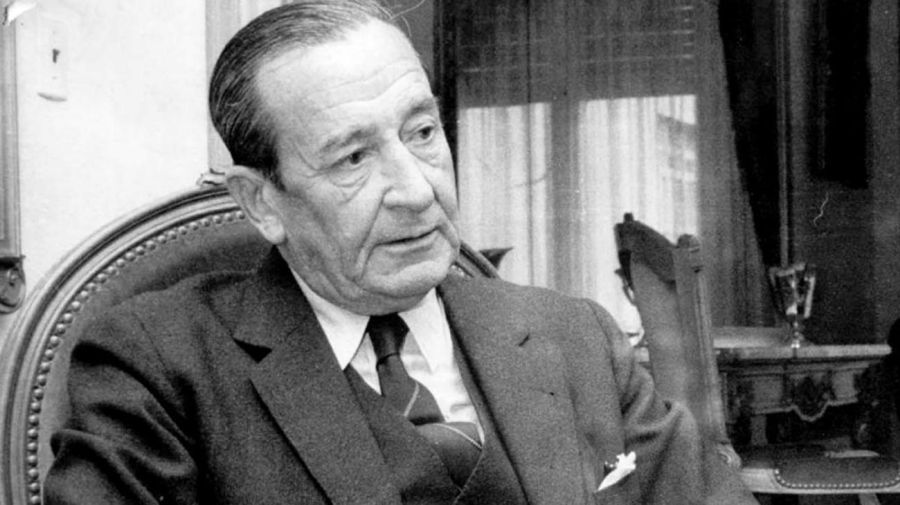
On May 29, 1970, the Montoneros guerrilla group kidnapped former president Pedro Eugenio Aramburu.
It was a special date for the so-called “Peronist Resistance”: that day marked the first anniversary of the popular uprising known as “Cordobazo.”
The de facto general Juan Carlos Onganía ruled the country amidst social demands and internal struggles within the armed forces.
Peronism was outlawed and its leader, Juan Domingo Perón, waited in exile in Madrid for the moment to return to the country.
In response to this prohibition, the Montoneros organization arose whose first objective was to have a “public baptism” based on some important event.
At 9 in the morning on May 29, 1970, a captain and a lieutenant first entered the building at 1053 Montevideo Street and went to the 8th floor.
The former de facto president Pedro Eugenio Aramburu lived there.
While they drank coffee, the soldiers explained that they were there to be guarded during the celebrations for Army Day.
A few days before, the Onganía regime had withdrawn police custody, so the general was not surprised by the visit.
After chatting for a while, the lieutenant took out a machine gun that he had hidden inside a raincoat and told Aramburu: “you are coming with us.”
The soldier left with them without offering resistance.
The kidnappers were actually two 22-year-olds: Emilio Maza and Fernando Abal Medina.
Outside the building, Mario Firmenich, dressed as a corporal, was waiting for them; and Norma Arrostito aka Gaby disguised with a blonde wig.
Days before, Firmenich had posed as a student to enter the library of the Champagnat College, which was found right in front of Aramburu’s home.
From his windows he was able to observe all the movements of the future victim of what was called “Operation Pindapoy”.
Aramburu and his kidnappers got into two cars and, after making several changes of vehicles, headed in a truck to Timote, a small town in Carlos Tejedor, 450 kilometers from Buenos Aires.
They took alternative dirt roads to avoid possible police posts, so the trip took about eight hours.
Upon reaching the town, they went directly to the ranch house “La Celma” belonging to the Ramus family, one of its members, Carlos Gustavo, was a member of the Montoneros.
Aramburu was taken to a room where a few days later what the guerrillas called the “Revolutionary Trial” will take place.
He was accused of three charges: the execution of 18 soldiers and 9 civilians in the garbage dumps of José León Suarez -what Rodolfo Walsh would later call “Operation Massacre”-, for the theft of the body of Eva Perón and for organizing a military coup against ongany
The mock trial ended in three days and, predictably, he was sentenced to death.
Aramburu was taken to the basement of the place and put him against the wall. Fernando Abal Medina shot him in the chest with a 9-millimeter pistol. Several coups de grace followed.
The General’s body was buried right there and Montoneros issued a statement reporting what had happened.
In this way, the guerrilla organization will develop its objective: to make its appearance on the national scene after a shocking event for public opinion.
Eight days later, the junta of commanders dismissed Onganía and put Roberto Levingston in his place.
The assassination of the former de facto president marked the beginning of the most violent decade of the last century in Argentina.
On May 29, 1970, the Montoneros guerrilla group kidnapped former president Pedro Eugenio Aramburu.
The story is also news on Radio Perfil. Script by Javier Pasaragua and locution by Pita Fortín.
As the cost of capital climbs, pursuing growth transforms into something far more nuanced than…
Released in December 1997, James Cameron’s Titanic emerged as not just a box office juggernaut…
Hard-to-abate industries such as cement, steel, chemicals, refining, and heavy transport account for a large…
Switzerland’s international financial and trading hubs have traditionally served as powerhouses for banking, wealth management,…
A slower-growth environment is characterized by modest demand expansion, cautious consumer spending, tighter capital markets,…
Cybersecurity threats have shifted from being a technical concern to a central business risk. As…