

The double-digit rise in food prices that INDEC guarantees in the April measurement and that would be sustained in May generates a lot of concern in the Government, for which reason it ruled out using the controversial food imports.
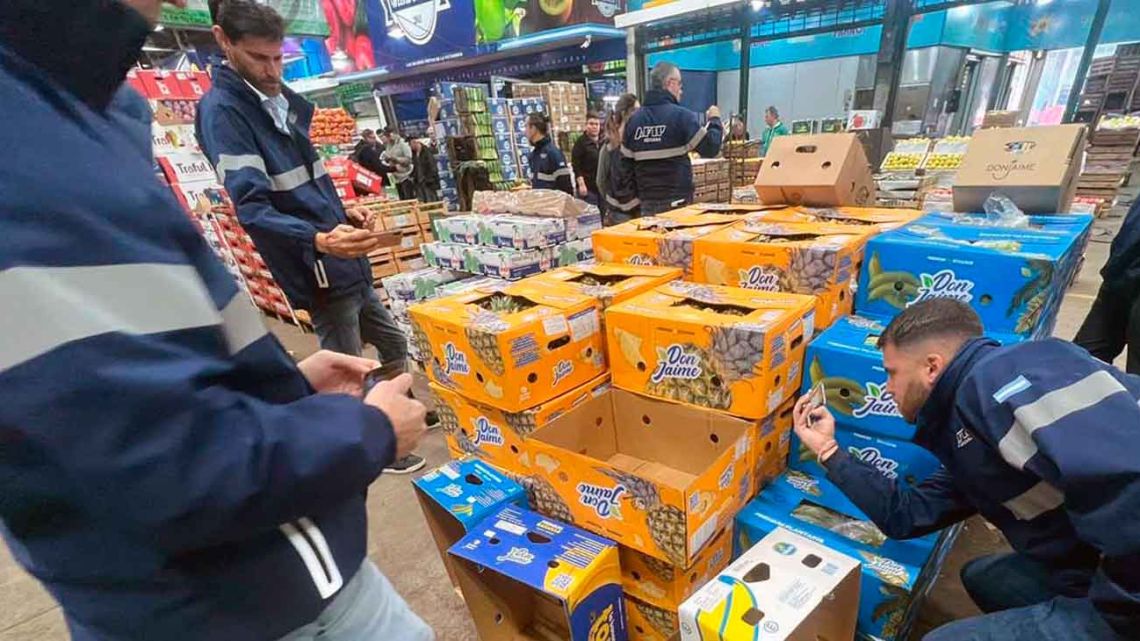
Although the measure is not 100% implemented, this week progress was made on the regulations that would allow a computer link between the Central Market and Customs to put this decision into operation, which generates controversy among the different sectors.
Producers, economists and storekeepers spoke with PROFILE, and agreed that it seems impracticable and that, if it comes to fruition, it will not have positive results.
The price of the products that the Central Market would begin to import grew well above general inflation. According to a study by the Faculty of Economic Sciences of the UBA, vegetables have increased by 185.3% and fruits by 180% year-on-year.
However, little of that increase reaches the first link in the chain. “We are using a kilo of apples for $140 and a kilo of pears for $40. Why does $500, $600 arrive? Because of intermediaries, freight and taxes,” said Edgar Artero, president of the Chamber of Producers of General Fernández Oro, Neuquén.
“That they open the importation of tools, tractors and pesticides,” added the producer. “We are competitive when they give us tools to compete.” In a context in which the sector’s competitiveness was hit by the drought, concern is growing for producers that they can stay on their feet. “It is inexplicable that there is flexibility to import products that are made in Argentina,” said Fabián Hryniewicz, president of the Formosa Chamber of Small and Medium Enterprises (Capymef). He also assured that, although it was necessary to know the fine print, these measures would be limited “to those who have the possibility of moving to the Central Market.”
For the moment, the sources of the Ministry of Commerce consulted by PROFILE assure that they cannot give details on how and when the provision will be used, but that the meetings will begin next week. From the Central Market they also commented to this medium that they hope to have news in the coming days. What is known so far is that the measure would cover fruits, vegetables, meat and non-perishable dry products.
“From what I understand, the Central Market cannot be bought by itself. It seems to me that it is one of the many lies of this government”, affirmed the president of the Chamber of Industry and Commerce of Meat (Ciccra), Miguel Schiariti, who was also president of the Central Market in 1989.
Even with the registration of the Central Market in the Registry of Importers as planned, “the measures that were announced are not on the way to lowering inflation,” said María Castiglioni, economist at C&T.
“Once it is imported at a lower price level, the evolution of these imported products over time will depend on the official exchange rate, plus international inflation,” he explained.
For Santiago Manoukian, Ecolatina economist, the main problem would be the availability of dollars to be able to import these foods. “The BCRA’s net reserves are negative by close to USD 1.3 billion,” he stated.
There is also uncertainty about the start-up. “The merchandise can reach the Central, but from there there must be logistics,” said Fernando Savore, president of the Federation of Warehousemen of the Province of Buenos Aires (FABA). “If this is only for Buenos Aires, we already have 135 municipalities with extremely long distances.”
From the sector, he explained, “if there is a product that has an affordable price, obviously we want to have it.” But the president of FABA was also critical of other measures announced and which for now have come to naught. “The Fair Prices format was concentrated in hypermarkets”, he concluded.
Salvador Femenias, from the Argentine Confederation of Medium Enterprises (CAME), stated that although it is not yet known how it will work if it comes into effect, in practice “food imports from Mercosur already have zero tariffs” and, on the other On the other hand, “the food problem is not a lack of supply.”
According to economists, the issue of inflation goes much further. It has to do “with the devaluation of our currency” and with an important monetary issue “to finance the Government, which has been increasing in recent weeks,” Castiglioni explained.
The economist added that she does not remember cases in which food has been imported to lower inflation. “There is the history of importing chickens from Mazzorín, which was obviously a scandal and they rotted” and a sample, according to the specialist, “of how difficult it is, in a country that exports food, to import them at large.”
You may also like