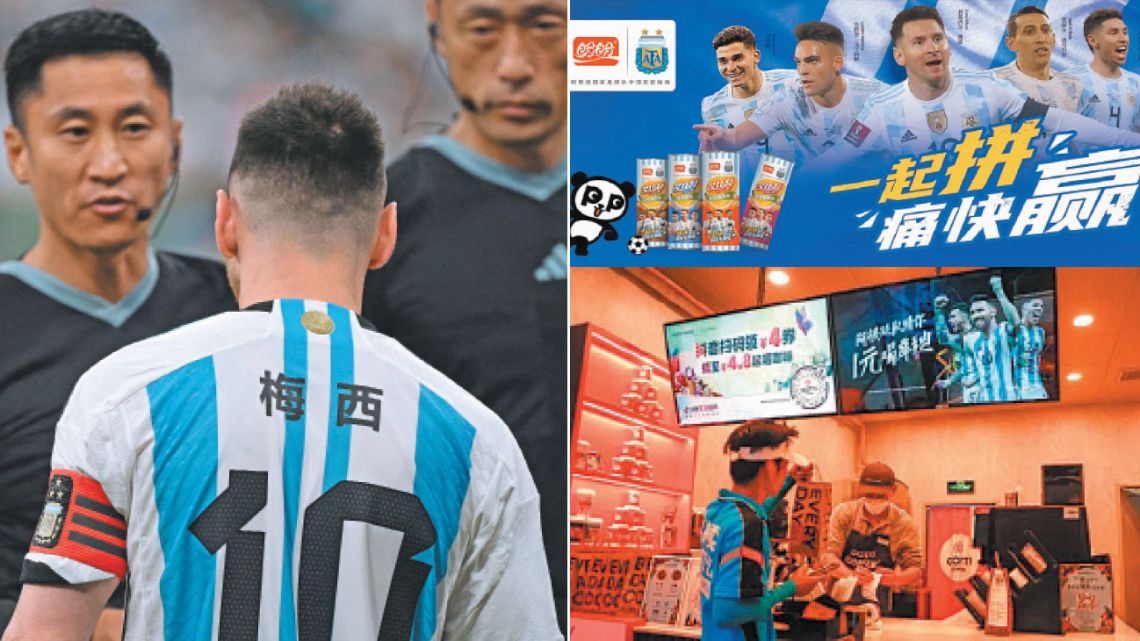

The symbol was on the back, above the numbers. Messi dribbled, Di María ran, Dibu saved, but the 68,000 people who were in the Beijing Workers’ Stadium – plus the millions who followed the game on television and their phones – enjoyed this detail that was given for the first time in history: read the surnames of the soccer players of the world champion Argentine team in Mandarin Chinese. It was not a gesture to ingratiate himself with the public, but a great business: thousands bought the shirts that Adidas shot to the world in the friendly of the National Team against Australia.
However, those numbers were just a sample of the millions that the Argentine Football Association (AFA) reinsured for the next few years in China and Asia, perhaps the most fanatical region of the National Team outside of our country. The furore in South India and Bangladesh during the World Cup in Qatar is just validation of that.
The Chinese is not a new fanaticism: for a decade the AFA demonstrated that the euphoria for Messi and his teammates could be translated into millionaire income. The first step in designing this regional strategy may have been the superclassic of the Americas that Brazil and Argentina played on October 11, 2014 at the Beijing National Stadium (and which Brazil won 1-0). The second, the agreement that Messi inaugurated with the Huawei telephone company to be the global ambassador of the brand.
From those two initial contracts until today, nine Chinese brands invested to wear the albiceleste shirt near their logos. Logos and advertising campaigns that we do not understand, but that speak the universal language of football: Messi, Lautaro Martínez, Julián Álvarez, Fideo Di María, Dibu Martínez and Rodrigo De Paul.
They are regional sponsors –only in China or Asia–, in most cases unknown companies in Argentina, but that move the ammeter of a country with a population of 1,300 million inhabitants. The technology NetEase Inc, with an estimated market value of 59.280 million dollars; Yili, China’s largest dairy producer, worth an estimated $26.44 billion; the leader in snacks Pan Pan Foods (because junk food is not only eaten in the United States or in the West) and the automaker GAC Mitsubishi appear as the strongest sponsorships. They are joined as regional sponsors by Kaiyun Sports, Lingxi Games and Wanjiale.
The most notable, however, is the agreement with Cotti Coffee, a kind of oriental Starbucks, because it became the first global sponsor of the Argentine team from China. It is one of the commercial novelties of this Asian tour of Lionel Scaloni’s team: the coffee chain began as a sponsor in China, but since June it has expanded to the whole world.
If the AFA will charge $6,500,000 for the friendlies against Australia in Beijing and against Indonesia in Jakarta, or if it has already vastly outperformed Brazil and other national teams in the Chinese market with sales of jerseys and other apparel, NFTs and merchandising, to a large extent it is due to the agreement they operated with Wanda Sports, the exclusive commercial agent it has in that country. And although it has agreements in many other countries, the nine that remain in force in China make up a significant percentage of a cake that, in terms of sponsors, increased to –read carefully– 80 million dollars. The other important percentage is nearby, on the same continent. Claudio Tapia’s management replicates his strategy with China also in the Middle East, a region that prevails in the world baseball business thanks to petrodollars and that, since December, has had another intangible asset: the emotional memory of our most recent days. happy.